Friday, January 10, 2014

Have a What!

1/9/14 -Friday. It is the start of the weekend and I began by carrying Kino the block or so over to the lawn area by the lake.  As I lowered him he fell into a sphinx-like resting position.  I put my heavy shirt over him to keep him warm.  He used to be a cold weather dog, and we'd have to drag him inside on cold nights.  I guess times change. 

I sloped next to him facing away from the road, toward the pond.  My eyes were heavy, and I drifted into semi-consciousness, my arm resting protectively over his back.  After all, mountain lions are not out of the question here and Kino is defenseless.    At the edge of my consciousness I heard voices coming from an SUV behind us on the road.  The words "cute," made me think they had seen Kino.  No sense in turning around.  "Look at the babies!" was the next phrase.  I slowly turned over to with minimal curiosity.   The sight jolted me up into sitting position.   Four javelina, two of them young babies, had just passed right by us on the lawn, and were entering the dense mesquite bosque.  

My sitting up had alerted two other adults just ten feet to my right.  One barrel-chested adult had squared off, assessing the situation.  I was assessing the situation as well.  Javelinas, while not typically a threat, but are very protective of their young, and dogs/people could be conceived as a threat.  And we had surprised them.  Kino would not be able to run away, let alone walk.  I then realized that two other adults were crossing to my right.  I had nine javelina on three sides of me, some within 15 feet.  Kino, oblivious to the situation, was surprised as I scooped him up to my chest.  If they charged I didn't want to risk a quick having to pick him up in a hurry.  Perhaps they realized I was just a protective parent too, or perhaps the stories of charging javelinas are more exaggeration than fact.  But they passed without concern except a rush to get back into cover. 

 As I carried Kino back home I was comforted by the curious excitement of the passengers in the SUV.   It was refreshing to see others with an appreciation of nature, especially the javelina.  I was also surprised that these stocky hoofed animals could approach so close, so silently,  without my knowledge.  Of course, these circumstances in life are when we are most "awake," and I am most thankful for the experience.  When was the last time you were awakened by a wildlife experience?  I'd love to hear it.  

Tuesday, January 7, 2014

Yard Wish List for 2014

While it is true I focus mostly on my neighborhood list my yard birds are very special as well.  A bird coming to your yard is an affirmation of your habitat-creating success.  I hope the log pile I put in may bring in a Rock Wren or House Wren again to our yard.   Or something new, like a Bewick's Wren, heard not even 200 yards from our humble abode.  So I figure I'll put down on paper some of the birds I hope may visit our burgeoning wildlife habitat in 2014.   What's on your list of hopefuls?

1.  Bewick's Wren-  perhaps the stone walls and log pile will attract this beautiful wren. 
2.  White-throated Sparrow-  often attracted to ground seed along with our White-Crowned Sparrows. 
3.  Canyon Towhee-  A resident of higher elevations but with some coming down to riparian areas. 
4.  Spotted Towhee-  Less common in lowlands but regular.
5.  Calliope Hummingbird-  we've already had the rare Violet-crowned visit, so why not this one or the next entry.  Hanging feeders low may attract this interesting looking hummingbird.
6.  Magnificent Hummingbird-hanging feeders high may attract this bird of high elevations.
7.  Western Screech Owl-  has probably visited but hope to see him.  
8.  Hooded Oriole- putting out oranges, etc.  could attract this striking bird.  
9.   American Kestrel- putting up screech owl nest box could also attract this colorful falcon. 
10.  Hermit Thrush-  Good cover and seed may attract this earthy-colored beauty.
11.  Cedar Waxwing-  our berry-producing plantings could bring in these birds. 
12.  Common Yellowthroat- if my cattail project takes off in the yard.
13.  Macgillivray's Warbler-  low dense cover will attract this olive warbler with white eye crescents.
14.  Tennessee Warbler- key will be gurgling water feature to bring in warblers to drink.
15.  Yellow-breasted Chat.  Cattail experiment and good cover may attract this bird of wetter habitats.
16.  Scott's Oriole-  an oriole of higher elevations but more likely in migration to oranges, nectar.
17.  Dark-eyed Junco-  attracted to ground seed.
18.  Harris's Sparrow-another ground seed feeder, usually with White-crowned Sparrow. 
19.  Blue Grosbeak-  may be attracted to water feature and denser habitat.
20.  Common Black Hawk- perhaps soaring over in migration in the next couple months.  

Thank you for appreciating all the visitor's to your own special wildlife habitat!


Monday, January 6, 2014

Weekend Special

Saturday we took an excursion to Phoenix to help our daughter and her fiance move into her new house by Encanto Park.  I realized, perhaps a bit late, that I was one of only two guys in our moving party.  Translation-we were the two haulers to the Uhaul truck, getting our step aerobics, power lifting, furniture carrying, exercise for the month.  Since everything seems to be an adventure for me, I just had to miss-step off the truck ramp once, cutting up my knee. 
But the house was so cute, with a guest house as well, perfect for a metalsmithing/ enameling workshop.  By the way, my best Christmas present was this breathtaking ornament she gave me.  Isn't it just incredible!
 I always said I wanted some of her artwork, even a necklace, for which I would get the, "Are you out of your mind, again!" look I know so well.  Being the only guy in a house with three strong women teaches the lesson of humility often.  Of course I had Kino beside me, but his good looks kept him out of trouble for the most part.  
As we unpacked the trailer I of course got distracted by birds, counting 15 species for their yard list including cormorants, Rosy-faced Lovebirds (very appropriate for the romantic homebuyers), and an Inca Dove.   A Eurasian Collared Dove shared a perch with a probable Ringed Turtle Dove, and a Northern Mockingbird competed in song with a Curve-billed Thrasher.   
Eurasian Collared Dove and Ringed Turtle Dove


Poor Kino missed out on the fun so I took him on a trip up Mount Lemmon on Sunday.   I knew he was ready by his nervous energy in the morning, and he sat upright the whole way up the mountain, enjoying the scenery and, of course, 70's and 80's rock.   We shared my favorite, Carmela's Caprese from Beyond Bread, and he grudgingly posed for some pictures. 


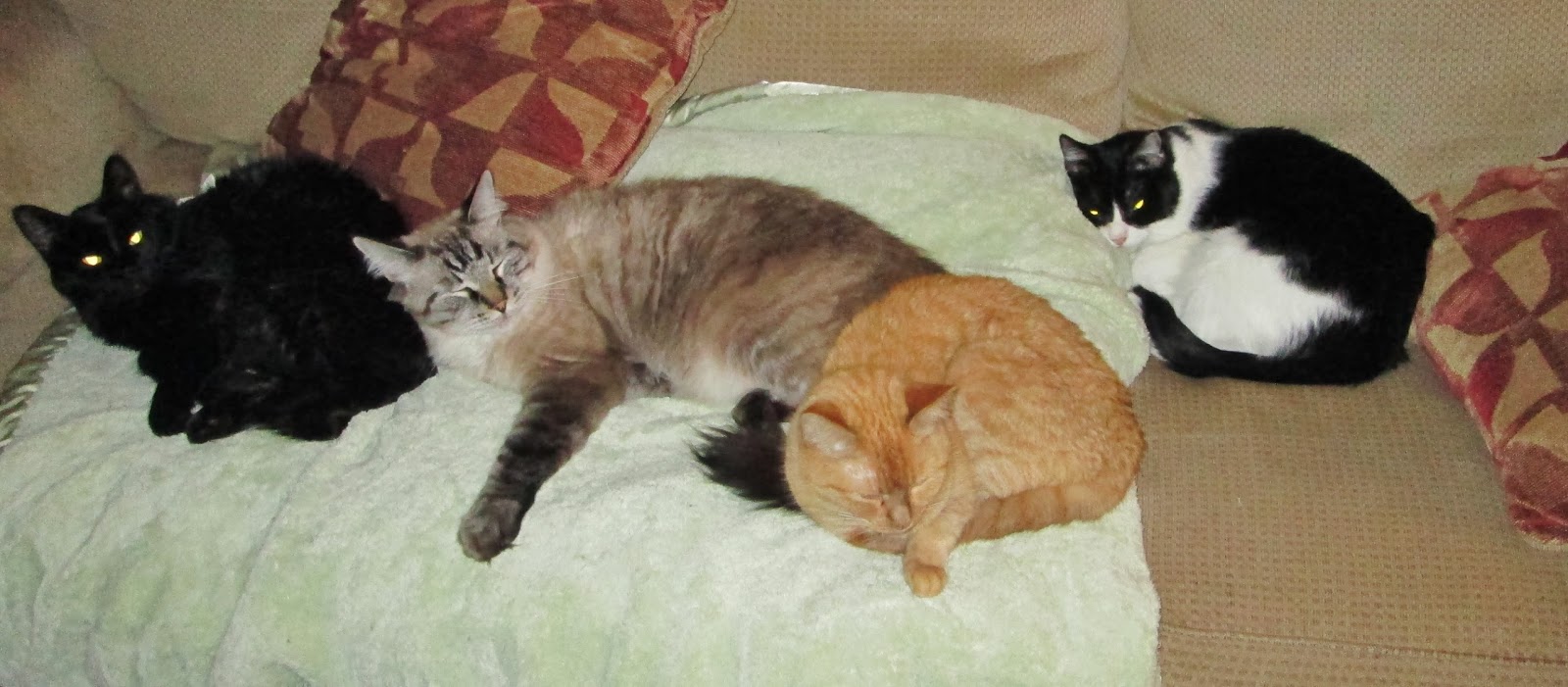
 Kino really enjoyed the trip.    When we got home he slept soundly for a good while.  When he woke later he acted a little distressed, almost insecure, an unusual trait for this independent guy.  Usually when he whines it involves food, water, or when our daughters visit.  Perhaps his arthritis was bothering him.  I finally just picked him up and sat on the couch, cradling him on my lap.  This was apparently the remedy for he stretched out and leaned into me, his head resting against my arm (sorry, no selfies).  We sat for so long that when I got up my leg muscle cramped up immediately.   Tonight he is at my feet and relaxed, and the kitties are taking advantage of the coveted,  blanketed couch.   Lilly and Hadley took the high road, cuddling up on the climber like best buds. 


Lilly and Hadley-best buds

Oh yes, I forgot this is a nature blog, right.  Well, actually it may be more of a journal.   I should be birding more since I'm leading an afternoon field trip in a couple weeks for Tucson Audubon Society.  The trip is almost full so I''d better get get some scouting in, perhaps next weekend, after Kino's bath, and the vet.  Probably Sunday.  Or the next Saturday just before the trip.  Wish me luck!  Thank you for appreciating all the special things in this wild ride, life. 

Friday, January 3, 2014

Remembrances of Catalina Mountain CBC-Day One of "Count Week."


Written on 12/13/13 (Day 3 of Count Week)
Tomorrow I embark on a yearly adventure, the Christmas Bird Count-Catalina Mountain edition. This particular count has been in existence for about 80 years, with only 2 compilers during that time, the late Gale Monson, and Bob Bates.  Bob was my first mentor when I arrived in Tucson and has had a great influence on my birding and confidence.  His support and encouragement has helped motivate me to make a difference in this count circle, and I've been lucky enough to find a few birds to add as firsts to this circle.   I remember our first addition to the list, eight Common Goldeneye Bob spotted on the cattail pond on our first outing together.  

The goal of the Christmas Bird Count is to get a snapshot of bird populations worldwide, using the data to assess bird populations and identify trends in distribution over the years.  That is the big picture.   On a more personal note the goal of some citizen scientists such as myself is, "to see every bird species that has been seen in the area for the past month, and a few new ones as well."  This goal has the same odds of success as winning the Powerball Jackpot... without buying a ticket.  Luckily scouting efforts can be rewarded since birds seen 3 days before and 3 days after the count can be notated as "Count Week," birds if not found on count day.   Scouting for count week birds before the count has more value since it gets you pumped up for the CBC, and also makes rarities easier to spot on count day.  

Paul and I set out Wednesday on our search for count week treasures, focusing on birds he and I had seen in the past few weeks.  Before meeting up I took a short jaunt to the big lake, where the continuing Red-breasted Merganser female was waiting, a first ever for this eighty year old count.  To the right were 3 Hooded Mergansers who had just arrived that day, a bird not always seen on count day.  That night a male Common Merganser would complete the trifecta of merganser species, 3 in one day, and on the same lake!  

 I picked up Paul and we went in search of our next gem, a Magnolia Warbler he had discovered some miles east up the wash.   After a short walk his sharp eyes spotted it flitting about a cottonwood, and we snapped documentation photos.   This was our second first ever bird for the Catalina CBC, and a life bird for myself (1st time I've seen it in my life).  My excitement was immeasurable.  We also encountered a Gray Flycatcher and two Ash-throated Flycatchers, which are uncommon in winter.  


UI Empid flycatcher


Another birder walked toward us down the wash in search of the warbler.  It was John Higgins, birding away from his western Tucson haunts for a day.  John is always finding great birds in his neck of the desert, and is an incredible field trip leader and organizer.   As the three of us walked back up the wash Paul spotted a small flycatcher in the empidonax genus.  This genus includes birds that look very similar, so much so that some cannot be identified in the field.  
UI Empid flycatcher
This bird did not give any definitive behavioral clues to its identity, but definitely was not dipping its tail as a Gray Flycatcher would.  It seemed very small, and did perch low, sometimes only a foot off the ground.  It did not fidget nervously and we agreed it did have a short primary projection.  This latter field mark would seem to indicate a Dusky Flycatcher, which had not been recorded on this count since 2004!  We followed the bird through the mesquites until it allowed a decent photo opportunity.  

Later, as Paul reviewed the photos he had an interesting observation- the dark tertials contrasted with the broad light-colored wing edges.  This trait could indicate a Least Flycatcher, which otherwise has very similar traits to a Dusky Flycatcher.  This rarer possibility had never been seen ever on the Catalina Mountain CBC!   Paul sent the pics to our friend Mark.  Hopefully we can solidify an ID on this interesting empid flycatcher!

We finished the morning at the cattail pond, searching for a rare Yellow-bellied Sapsucker I had seen the day before.  We found it, and its similar cousin, the Red-naped sapsucker attending to the even rows of drilled holes they had created in the Eucalyptus trees.  It was an exciting day with great finds, and a couple missed rarities to search for the following day.

Wednesday, January 1, 2014

Capturing moments


My New Year's Day was probably uninteresting to readers.   Sassy our cat used my leg as a pillow, and we all took a nap together.  I watched some birds in the yard, and went to a movie tonight.  The only so called work I accomplished was unloading some logs into our back yard for stacking.  At least I seemed to finally knock the remainder of the flu out of my system. Kino was as unenergetic as I, and wasn't up for a trip up Mount Lemmon today.  

When I got back home tonight Kino and I lay on the floor, and I ran my fingers through his fur in long slow strokes as he rested his head on my upper arm.  It occurred to me that when he's gone I will not be able to truly relive these bonding moments.   Whenever I take pictures of him I am always disappointed that the camera doesn't fully express the love in his gaze, or the intense emotional impact of the moment.   It can't record the powerful emotional exchange of energy, like when your kitty pressing her chin on your leg in trusting love while she naps with half closed eyes.   There is a positive
Kino and I (selfie)
loving energy force we have not been able to capture on film, except in very rare  circumstances.   If we could invent a way to recreate these treasures for future playback the world would respond with great need.   Our memories, sometimes sparked by photos, are our best means for this need currently, but are time sensitive and difficult to share with others.   I suppose my realization of this need is amplified by Kino and the reality of the shortness of time we have left together.    

Daniel Boone (Deebs) with his armrest

So that was random I guess.   To change topics I suppose I can write a list of New Year's resolutions.   I know many birders use the New Year for projecting number of species they hope to see in the year.   My focus is more in finding birds close to home, or just connecting with nature in general.   I learned early that chasing rare birds has never been as exciting as discovering them in my neighborhood.  It can be expensive as well and takes time away from Kino and our kitties.  So without further ado, here is my list.   

Spend quality time with Kino and our kitties, same as last year.  
Set up automatic drip for our plants.
Improve our yard to be more wildlife friendly-greater diversity.
Invest in a water fountain whose main focus is for the birds.
Write draft for a book on wildlife appreciation.  
Blog more- say 150 entries for the year.
Improve wildlife photography. 
Gain more insight to blogging techniques, especially technical aspects (any tips welcome)!
See 250 bird species in Pima County for the year.
Use Ebird more. 
Find my voice and express it without fear. 
Invest time in meditation/yoga type activity (inner peace exercise).
Mrs. S's list -not to be disclosed publicly.
Appreciate everything as a gift or an opportunity.

Thank you for your appreciation of life, and all who share it with us.  


Monday, December 30, 2013

Just Can't "Leave," Well Enough Alone


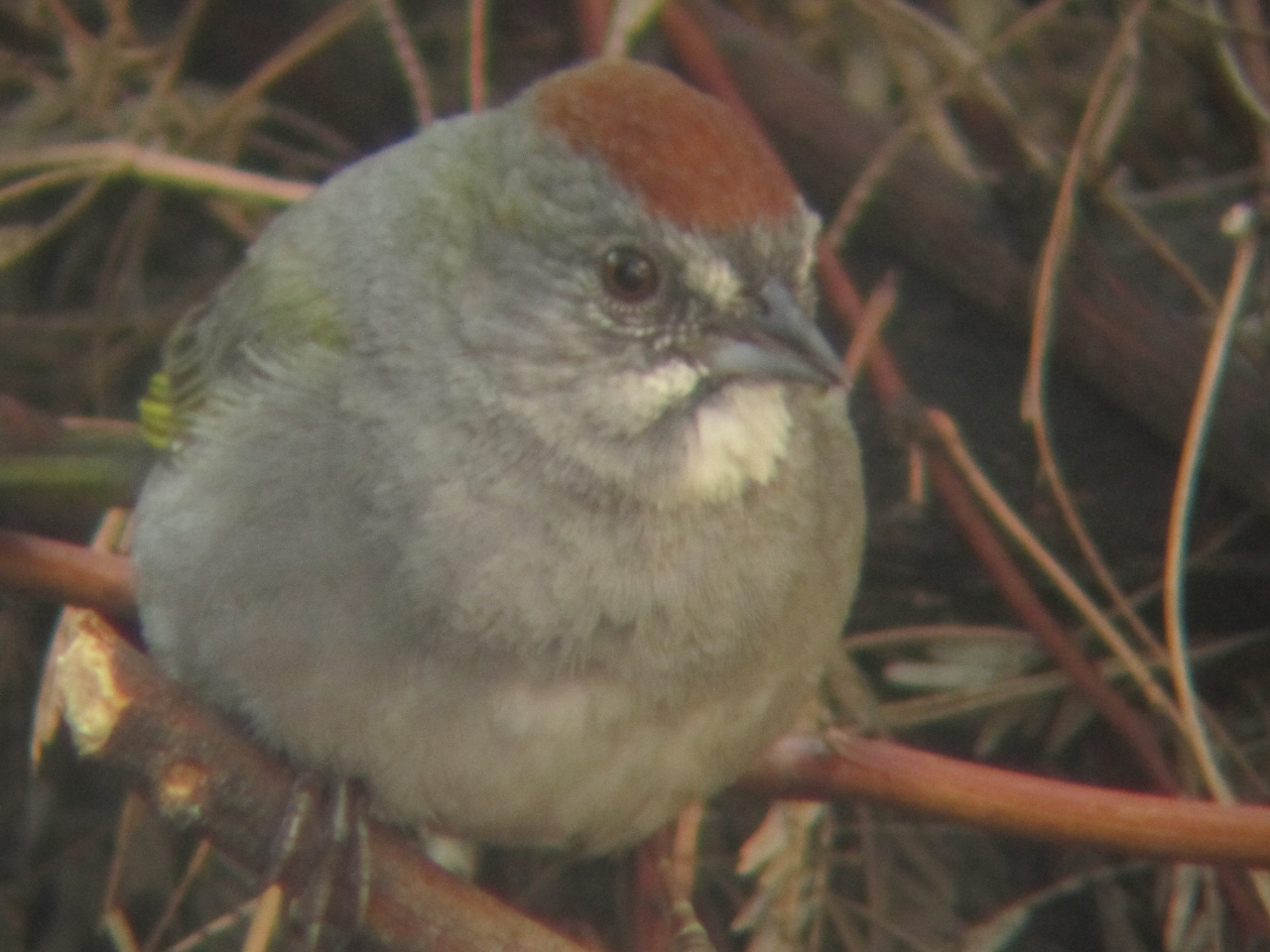
Green-tailed Towhees like this one love to kick up leaf litter.
Instead of snow falling this Christmas we are experiencing the soft descent of earth-toned leaves from all of our beautiful cottonwoods.  I love this time of year since it gives me an opportunity gather leaves from our common areas, using them to "birdscape," our back yard with leaf cover.  Leaf cover has many benefits, including.
1.   Keeping your plants roots warm on frosty winter nights.
2.   Keeping moisture in the soil longer after winter rains by shielding it from the desert sun.  
3.  Creating mulch as it breaks down.
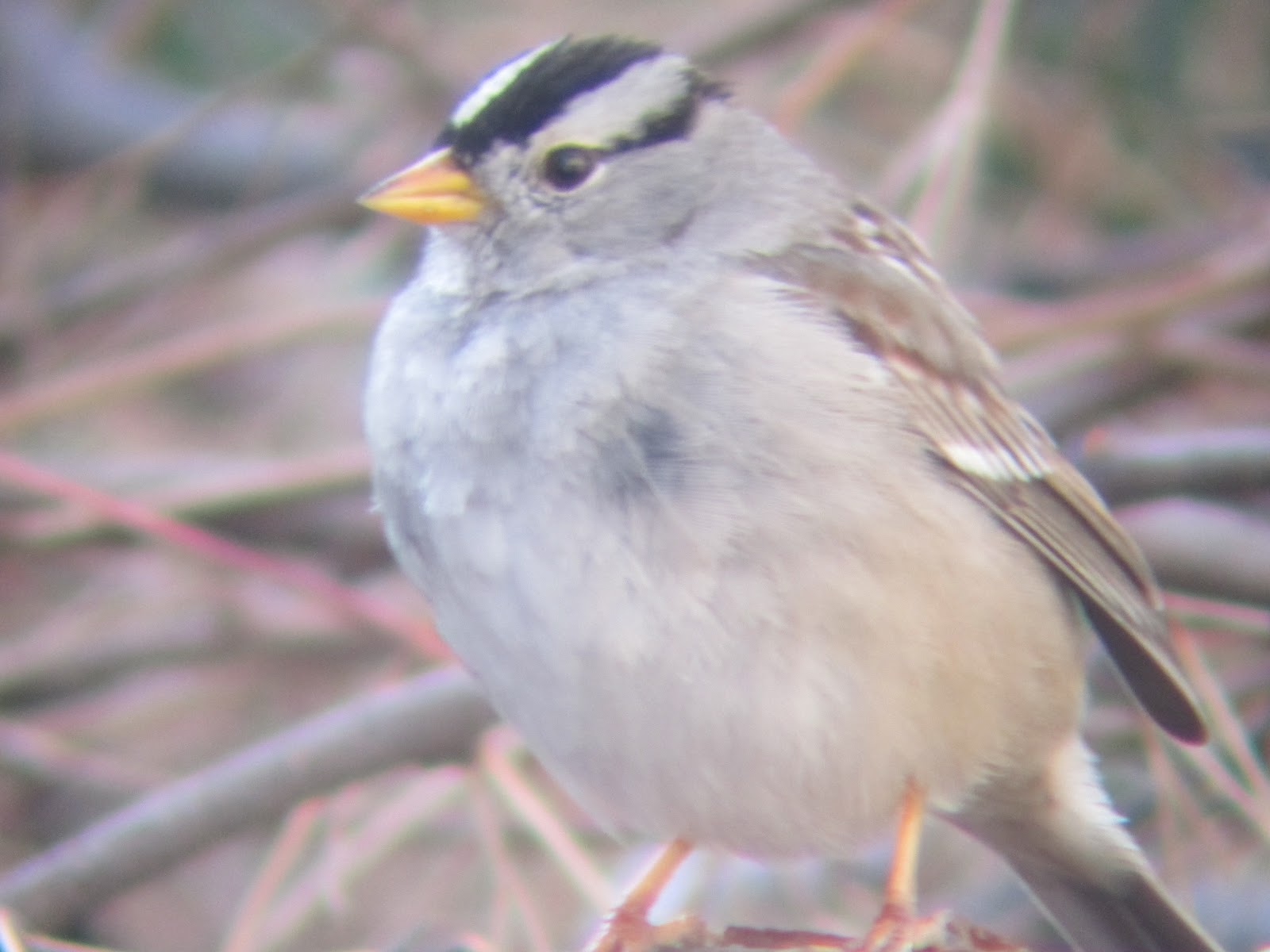
White-crowned Sparrow-also a leaf kicker.
4.  Giving a home to insects, attracting the birds which feed on them.  Towhees, thrashers, and sparrows love to kick up the leaf litter with their feet (or bill) looking for food.  
5.  Giving a "woodsy," feel to your yard, like a walk through Sycamore Canyon.  
6.  Keeps your micro-climate cooler by not absorbing the sun's heat as much as stones or exposed soil. 
7. Provides cover for birds while they feed, its texture making it easier for birds to disappear against the landscape.
8.  The leaves can act as a cup, capturing rainfall for wildlife.  


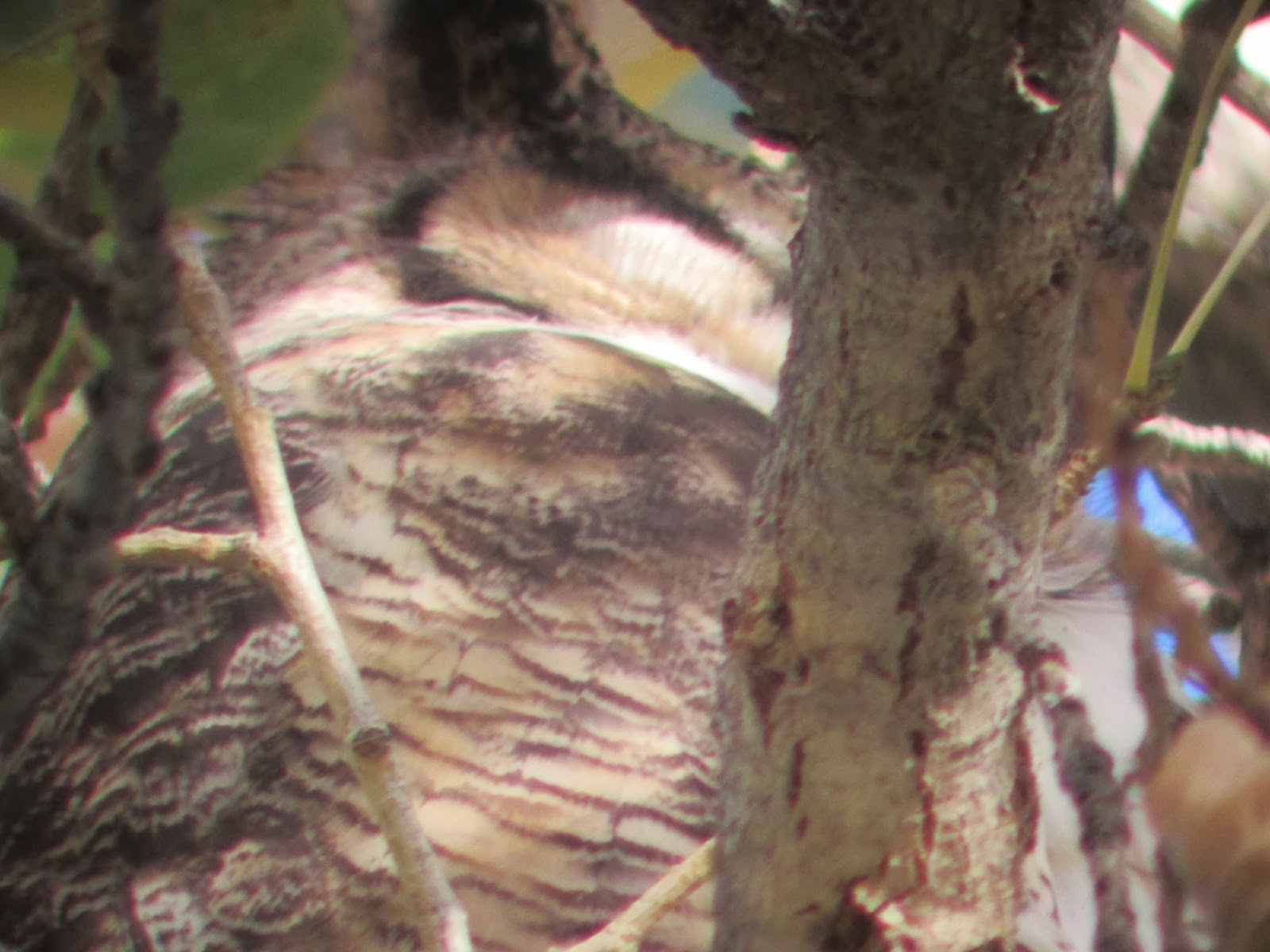
As I was gathering leaves I knew I was being watched from above, but by who, or rather whom?  It was a couple Great Horned Owls roosting in the cottonwoods, practically invisible, especially when their eyes are closed. As darkness closed in they bellowed deep, tuba-like hoots back and forth, oblivious to my presence.   


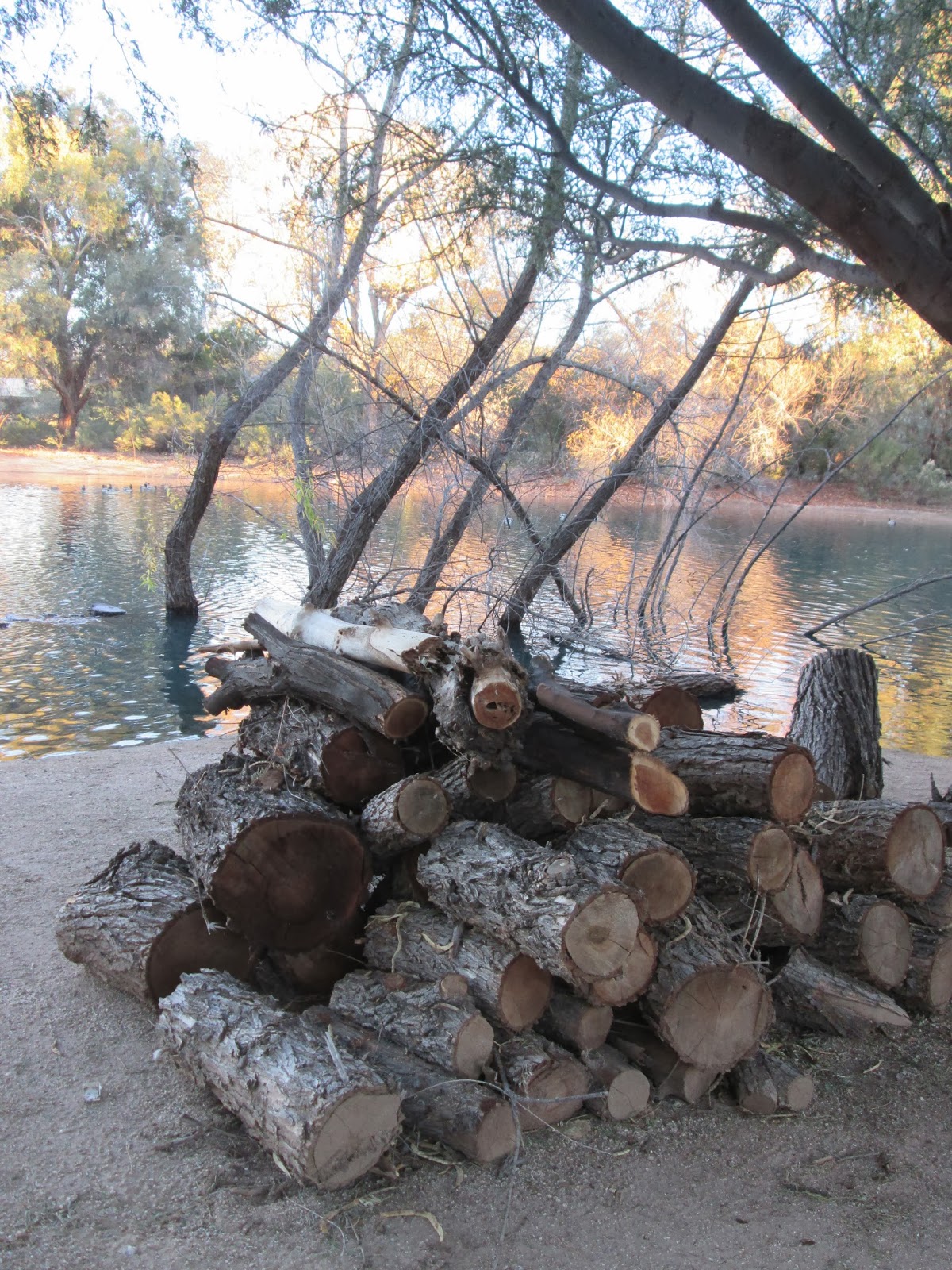
Log pile after one car load removed
Over a few days I managed to collect 15 bags of leaves for our backyard heaven.  I left some leaf litter around the roots of the cottonwoods, and some in other places to help the owls hear the rustle of mice in the night.   I knew the landscapers would probably clear them soon but even a few days can make a difference.   

While at the cattail pond I eyed a woodpile from a "trimming," of Gooding's Willow along the bank.  I couldn't resist bringing the logs home to create a woodpile habitat, knowing its life by the pond was limited.  It had already been home to a small snake, who left its shed skin as a keepsake.  I was particularly interested in two round knotted pieces with small cavities as potential for improvised bird houses.

When I got home there was a message from Mrs. S to meet at our favorite eatery, Beyond Bread.  I hadn't had time to remove the bags of leaves from the back seat, and the rich, intoxicating earthy aroma carried me back to my childhood, when we would rake leaves for hours, creating huge piles to jump into from the top of the"big rock," in our front yard in New England.  The leaves became a huge pillow, breaking our freefall softly as they enveloped us with the bouquet of decomposition, a return to the soil.  My grandmother would sometimes visit, working alongside us with an unstoppable work ethic, escaping the blisters we gained from inexperience.  Her seventy-year old body was hard as nails, yet her heart glowed with warmth, especially  toward her children and grandchildren.   I'm glad now for my upbringing so close to nature.  I remember turning logs over to find salamanders and all kinds of insects, of seeing deer pass through the yard, or finding a Pileated Woodpecker in the nearby swampy habitat.  It was an area of ridges and fields, streams and lakes, where my canoe brought me closer to nature, and sometimes to risk and adventure.  I suppose I can raise a cupful of leaves to my face and breath in the rich memories of yesteryear, of youth, of nature and all the gifts it has bestowed upon my soul.  Come join me in appreciating the richness of our natural world and its wonderful earthly inhabitants.
Grandma O'Reilly and us sitting on the "big rock."


Wednesday, December 18, 2013

Catalina CBC Adventure

It was one O'clock AM as I parked by the recreation center pond.  As my eyes adjusted to the darkness a meteor streaked across, slicing through the handle of the Big Dipper.  A Great Horned Owl called, then another.  It was a good start.  I played a tape of a Western Screech Owl.   Western Screech Owls are like meteors when they approach in that you ask yourself, "Did I just see that or was it my imagination?"  But the branch twitches, and you know he's there, camouflaged by the darkness and his gray, tree bark-like plumage.  Then it sings its melodic bubbly repertoire of whistled notes, a slow trill in response to your imitation.   You freeze, holding onto this unique experience, unforgettable no matter how many times it is replayed in your life.   You realize you have received a gift this peaceful moonlit night.  

   My first few stops did not have any responses.   I started playing the song at a reliable location along Speedway, and had an immediate response just as the eighth meteor passed overhead.  Seven more screech owls would be counted that night along with another 30 or so meteors.  The most special screech owl was behind the cattail pond since I hadn't heard one there in years, despite the appropriate habitat.  The first the calls were non-typical, and foreign, but soon the small hunter changed to the familiar trilling so musical to my ears.  

When I met up with Jake at 7:00 only one other Great Horned Owl had called in the night, but we would find four additional owls roosting on our wanderings that day.   We scanned the big pond for ducks, counting good numbers but lower than usual diversity.  We had missed the influx of rarities a few days earlier which included 3 merganser species.   As we drove off a raptor stood out on the magical Eucalyptus in our neighborhood.   Closer inspection unveiled a Peregrine Falcon, arguably the fastest animal on earth.  It a good sign to find this tough bird early, for it can be a very rare sight.  Before leaving the neighborhood we parked at the gate and walked to a hidden pond, where a female Bufflehead was a nice surprise.  
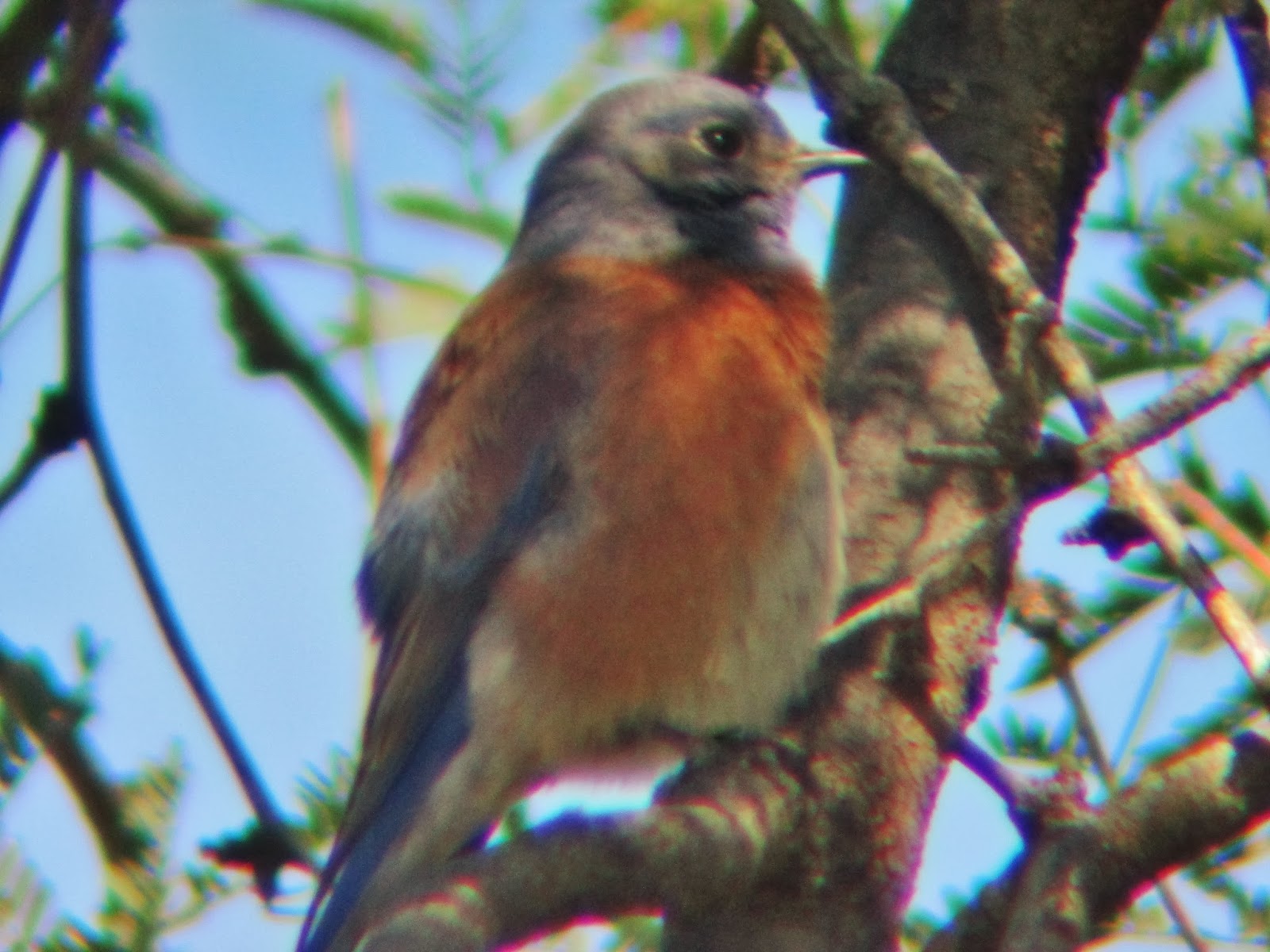
Each birding stop had some nice sightings.  La Mariposa resort was going green with a Green Heron and Green-winged Teal on its tiny pond.  Western Bluebirds sat on the wires over the wash. and a Prairie Falcon sat on a tall power pole over Speedway Blvd. A House Wren, uncommon in the lowlands, was another good find.  
A walk at the cattail pond produced our best bird of the day, a juvenile Yellow-bellied Sapsucker.  One of the keys to distinguishing the rare Yellow-bellied Sapsuckers from its cousin, the Red-naped is that the latter only retains juvenile plumage until late September, whereby the former slowly attains adult plumage over the winter.  2 Northern Pintail ducks were on the pond as well, a bird often missed on this Christmas Bird Count.  The somewhat dense cover on the back side of the pond held an Orange-crowned Warbler,  and the normally musical Hermit thrush only gave a one-noted "chuck," which was enough to alert us to its presence.

A walk in the field west of the pond yielded five Lincoln's Sparrows and our only Green-tailed Towhee for the count.  As we walked through the mesquite bosque an Ash-throated Flycatcher called, and an American Pipit flew overhead.   As we walked the wash back past the big pond highlights included Black-tailed and Blue-gray Gnatcatchers, 2 Brewer's Sparrows, and a couple Rufous-winged Sparrows.   A Pyrrhuloxia found along the walking path by the road would also be the only one for our area.   

A walk along Woodland Road added our third falcon species, an American Kestrel.  Chipping Sparrows and a few Lark Sparrows foraged in the grass, and a small group of seven meadowlarks (probably Western) were visible a hundred yards off the road.  Among the Brewer's and Red-winged Blackbirds were two Brown-headed Cowbirds, the only two found in our count circle.  Nine White-winged doves were an uncommon sight in a mesquite, and a brilliant male Red-naped Sapsucker helped round out our woodpecker totals.  

My friend Paul and his friend covered the eastern part of our route, and had tremendous success as well, having seen a Magnolia Warbler, a first ever for the entire count circle (which has been in existence for about 85 years).  They also found a Black and White Warbler, two Gray Flycatchers, the striking and scrappy Loggerhead Shrike, a Sharp-shinned Hawk, and a White-breasted Nuthatch, which is uncommon in the lowland habitats.   

The day ended with 85 species seen or heard by our two teams along this small yet ecologically diverse dense riparian area along the Tanque Verde Wash.  Twenty of these would not be seen by any other group in the circle!    Sunday would be a day of rest, having only had two hours of sleep the night before.   But the adventure was well worth the sacrifice, and I'm already looking forward for next year's Christmas Bird Count adventure.   Thank you for appreciating our diverse native wildlife.   

Tuesday, December 3, 2013

My Christmas Wish List along the Tanque Verde

Our family had a tradition of distributing a Christmas wish list on Thanksgiving, to be divvied up among the family.  I had 3 brothers and 3 sisters, so each person would have two siblings to buy presents for Christmas.   Since Thanksgiving has just passed I decided to create my own Christmas wish list.  These presents cannot be bought, but are birds I would like to discover within the boundaries of our neighborhood, additions to our neighborhood bird list.   This list currently has over 240 species but there is plenty of opportunity for others to be added for the first time.  Anything is possible along the rich habitats along the Tanque Verde.   In fact, the hardest task is condensing the possibles down from 60 to a mere 20, which are hoped to be seen in the next 5 months (then I can make my B'day list for the summer).   My choices will be based partly on probability based on species information in "Finding Birds in Southeast Arizona (FBSEA notated) and local knowledge.  Some will be given extra consideration due to an overwhelming desire to see the species in our neighborhood.    So, without further ado, here are my twenty top pics for birds hoped to be seen for the first time in our neighborhood.   


1.  Common Loon-  This rare winter visitant usually shows up on larger lakes (FBSEA).  Our big pond is just big enough for this amazing bird with the unforgettable song.   It has been on my wish list for a long time now.  

2.  American Bittern-  This winter rarity is attracted to cattail ponds, and I hope this is the year it visits our cattails.   I love it's song, which sounds like a slowly dripping faucet into a bucket of water.  We have already had Least Bittern as a visitor at the cattails on a few occasions.

3.   Northern Goshawk-Northern birds can be seen in the lowlands in winter (FBSEA).  Has been seen in the last two years just a few miles away around Agua Caliente Park.  Oh how awesome it would be to see this magnificent accipiter, especially and adult.  

4.  Golden Eagle- can be seen in lowlands and agricultural areas in winter (FBSEA).  Has been seen during CBC around Agua Caliente on a few occasions.   One Ebird report on 10/12/11 on the woodland road.   

5.  Mountain Plover-  Although not seen in Tucson yet has been seen in fallow agricultural fields (FBSEA)..   Most likely too be seen along the fields bordering the woodland road.  

6.  Bonaparte's Gull-  Rare transient and casual winter visitant to ponds and lakes (FBSEA).  One has been seen regularly  in the past month at Lakeside park.

7.  Burrowing Owl-  locally can be year round in Tucson but not in northeast Tucson region.   Mrs. S found one at our local bank just a quarter mile from our neighborhood Martin Luther King weekend a few years ago.  

8.  Short-eared Owl-  has been seen at Sweetwater Wetlands and our fields and open space would be appropriate habitat.  It would be a great find and harriers, which use same habitat, are seen occasionally.  

9.  Magnificent Hummingbird-  rare visitant to lowland feeders in winter.    They can prefer feeders hung high so I may try this tactic this winter.  

10.  Acorn Woodpecker-  After my possible sighting last week this species would be a great addition.   One was also seen a a Udall Park a couple years ago, just a mile from our neighborhood.  

11.  Hairy Woodpecker-though probably a long shot the Hairy Woodpecker ranges lower in winter.  I never thought Arizona Woodpecker would be on our list but one showed up in 2009.  

12.  Horned Lark-  "Common resident in grasslands and fallow agricultural fields, often abundant transient and winger resident..."(FBSEA quote).   This bird has been seen in areas south, west, and east.  The fields on the woodland road has probably had them but I have not found yet. 

13. Bridled Titmouse-  Seen at loop road a couple winters.  could show up in rich riparian areas in neighborhood, especially in winter.  

14.  Mountain Bluebird- can be numerous in areas just east of neighborhood.  I had it on my list but removed it since it was an old sight record and I would rather have it documented with pics.  

15.  Rufous-backed Robin-fall and winter visitant (FBSEA).  One was seen a 49'ers community one year.  Our riparian habitat would be conducive for this species.

16.  Black and White Warbler-  I keep hoping for this bird in our neighborhood yet it always seems to be seen east of us at Wentworth Road and, lately, a few miles down at the loop road.  Most likely places to look are at cattail pond, but could be anywhere. 

17.  Northern Parula-  based on two birds at the loop road and one last year at nearby Ft Lowell Park this could be the year for this beautiful warbler.  Probably best to check mesquites along wash, looking for warblers foraging higher up.  

18.  Fox Sparrow-  could show up anywhere in winter, either in dense thickets or at feeders.  I found one at the loop road during a Christmas bird count a couple years ago (red form).   

19.  Golden-crowned Sparrow-  even though this is a tough year on sparrows and habitat is lacking, I hope to see this bird in with White-crowned Sparrows this year.  It is a winter visitant in brushy habitats (FBSEA).

20.  Eastern Meadowlark-  this bird is so difficult to tell from its cousin, the Western Meadowlark, that I would have to have definitive pics or hear its distinctive "spring of the year," call.   It is uncommon in winter away from its breeding areas (south and east of Tucson), typically found in agricultural fields and grassy areas (the woodland road) ((FBSEA).

21. Chestnut-sided Warbler-  this is my wildcard pic-and makes my list a lucky 21 wishes.  This warbler has been seen at Sweetwater, and I would hope to expect it at the cattail pond, the most favored spot for any vagrant warbler, actually.  It is a casual transient and winter visitant to riparian woodland (FBSEA).   It has been seen at Sweetwater Wetlands and nearby Sabino Canyon.  

So here is my wish list.  There were so many others I wanted to add, and if I started over the list could be completely different.   In fact, just warblers could take up 20 spaces, and sandpipers another 20.   Our diverse habitats in the neighborhood (fields, riparian, ponds, lake, cattails, pecan groves, cottonwoods) creates possibilities for almost any visitor to find a niche.    Wish me luck on my Christmas wishes!  Thank you for appreciating our current, and future neighborhood wildlife!

Ps.   Hope to have some pics to fill in next to these birds once seen!

Welcoming our pocket-sized neighbor

Our yard is looking brighter.  The Mexican Elderberry trees and wolfberry are leaving out, the Autumn Sage and Chuparosa have sprung red flowers to the delight of our hummingbirds.   The rock squirrels are not as active, saving some of our plants from their appetites and passion for digging.  One of the pitfalls of planting for wildlife is that some of the plantings will be eaten by wildlife.  Although the squirrels can try my patience, especially on new plants, I am glad for their presence in our tiny ecosystem.  Mrs. S. has a soft spot for them too, putting out leftover fruit and veggies for them to eat.  

Have you ever stopped and considered the labels we put on plants and wildlife.  These labels can create consequences which do not promote a healthy planet.  

The "weeds" are sprayed.
The "pests" are terminated.
The poisonous are eradicated.
The "feared," are attacked at will.
The "varmints," are campaigned against and blamed for low game numbers.
The "insignificant," are stepped on. 
The "dumb," are misunderstood or under-appreciated. 
The "game," is taken for sport.
The "cute," are collected.
The "ugly," are dispatched without remorse.

Most if not all wildlife can be put in at least one of these categories, and all, even the "cute," have a negative impact on the quality of the animal's life, or the species survival.  The biggest current threat happens in our own backyard, compounded by sprawl into natural areas.  Tortoises are collected, snakes, lizards, rodents, and insects are eradicated, native plants are removed, and bobcats, coyotes, and javelina are "relocated."   Many homeowners decide to "choose," which animal stays or goes, playing god with "God's creatures."  I wonder how a god would react if his masterpiece, his creation, is systematically destroyed by selfish acts of just one species.   Taking a bite of the apple surely is a minuscule act in comparison to plowing under the garden, right?

Imagine if all these descriptions were replaced with the word "welcome,"or "encouraged."  Dare I say "fellow neighbor."   Imagine if our struggle were focused on living with wildlife rather than campaigning against it.   This solution is easier than the current state, and even more economical. And it's not as hard as you think.  It may mean slightly more work in the beginning since we are adapting to our changing surroundings rather than fighting against it.   But we humans pride ourselves on being able to adapt, so we should be up to the task.  All beings struggle to live on this earth-it is one of the traits we share with other species-it is our special bond with them. 

So it is with this outlook that I welcome our new neighbor, the pocket gopher (Botta's).   He poked his head out of the newly formed hole the day after Thanksgiving.   He's "cute," but look at those chompers!  The next day one of my native grass plantings disappeared completely, a nice hole right next to it.  
Yes, he is welcome as all our neighbors.   I'm glad he is in the yard, though it will mean some change to our ecosystem.  But that is what happens in a balanced system, it changes like the ocean's tide against the shoreline.  Perhaps a hawk or owl will appear to change the balance again in our back yard.   Who knows what the future holds.  But our new visitor is as welcome as the Orange-crowned Warbler and Green-tailed Towhee who visited the day before, on Thanksgiving.     

So won't you welcome our new neighbor, Botta.  Thank you for living with, and appreciating, our neighborhood wildlife! 

A Christmas Miracle on the Tanque Verde

I felt like I was in a slump, that I had lost what little birding Karma I once had.   It wasn't that I wasn't seeing good birds.   It was just that the looks were too brief to call definitively.   The day before leading a bird trip I scoped out a prime riparian area with my friend Paul.  A brilliant male Summer Tanager came into the open for a moment, a nice rarity to show birders the next  day.
  Another warbler caught my eye with a yellow chest but disappeared before I could place its identity.   All I knew was that it was not one of our normal occurring varieties.   A scan afterward had me thinking best prospects to be Tennesee Warbler or Northern Parula.  
The next day the Summer Tanager hid for the trip.  So did the rare Black and White Warbler which had been seen, yet not by myself.   The trip still went well due to the enthusiasm of the participants including a 95 year old with the refreshing curiosity of a youngster.  A Peregrine flew by twice to excite the crowd, a Prairie Falcon perched nicely for scope views, and Hermit Thrushes were found at two lowland locations.   I counted 48 species in a few hours seen and heard myself, but not all could be shared visually with the nature enthusiasts.  
The next week my friend Paul rediscovered the warbler, a female Northern Parula, and found a brilliant male as well.   I went searching for the rarities without success, but heard a chip coming from some dense foliage along the road.   As I found the warbler with my bins it turned to face me and I saw dark stripes on a buffy background.  "Worm-eating Warbler!?" I exclaimed, to myself since I was alone.  It disappeared too quickly though, so I was not able to confirm with a second look, or better yet, photos.   I cursed my mixed fortune.    Was it the moon?
Weeks passed without another look at these rare gems along the Tanque Verde.  Even the Black and White Warbler was hidden from my clouded eyes.   I had a week off from work so set to work on a few bird surveys with Paul's help.   An unusually persistent rain  postponed one survey spanning the Tanque Verde wash west of the "bridge.".  
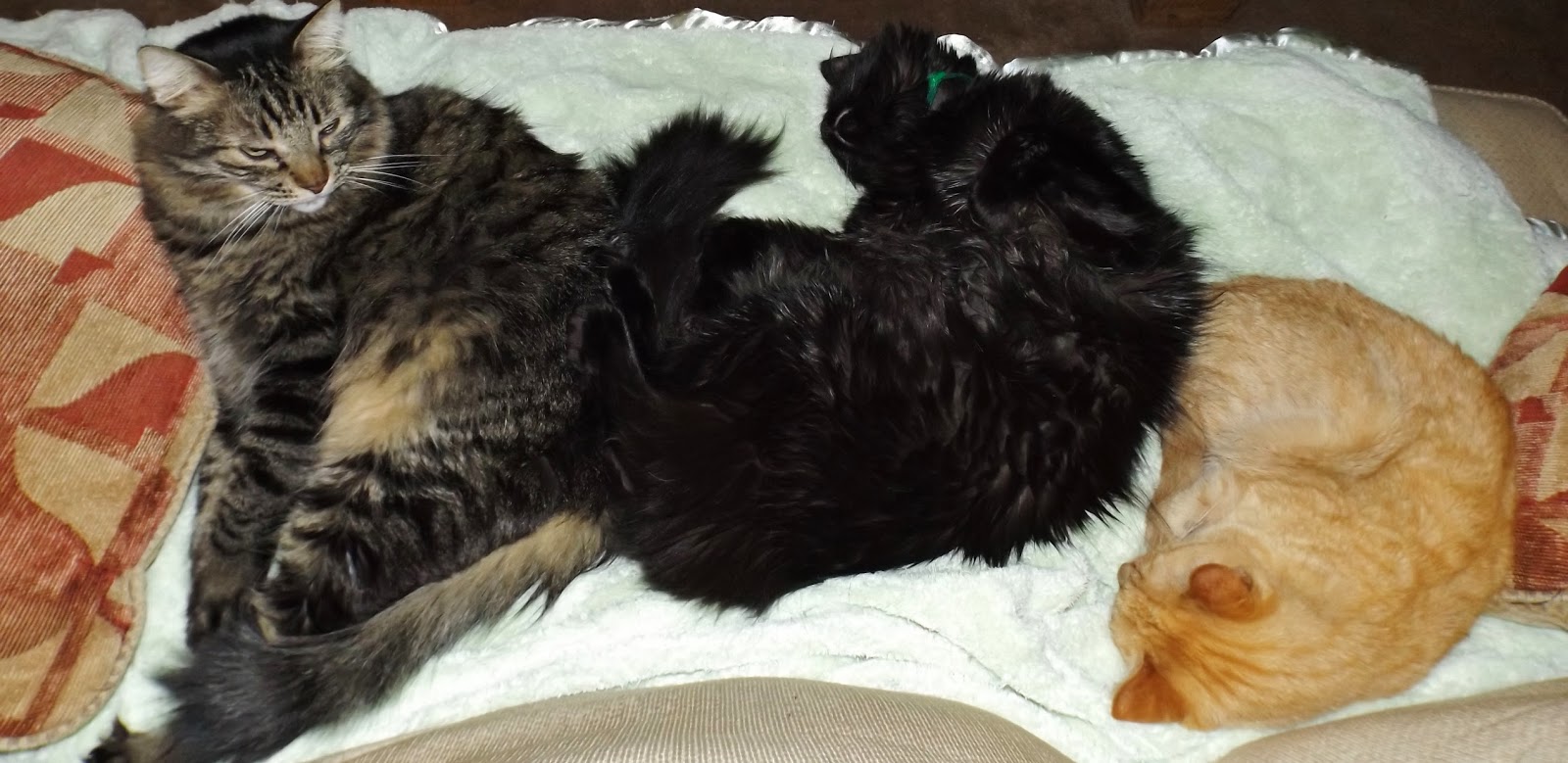
The next day we missed on all rare warblers and the tanager while walking by the loop road, but did see a Prairie Falcon and over 30 White-throated Swifts just before the survey ended.   I hoped my luck was not spreading to Paul's birding Karma, which is usually exceptional.   Could it have something to do with my close companions, who may have used my heavy shirts as a warm comforter lately?
Lilly, Scout, Sassy, Hadley
Deebs, Pickle, Sassy
I surveyed a short western section of the Tanque Verde alone.  I watched a Woodpecker with an all dark back and white wing bars as it flew across the wash into a pecan grove and disappeared from my view. Gila Woodpeckers fussed about, disturbed by this hidden competitor..  My gut and the field marks pointed to Acorn Woodpecker, a first for our neighborhood, even without seeing the clown-like face.   But, then again, Williamson's Sapsucker males have a solid dark back with white on the wings (and white rump too).   Gila Woodpeckers are territorial with sapsuckers as well.   I surmised that I had seen an unknown woodpecker, that would have been a new sight record for our neighborhood regardless of which specialty it turned out to be.  The mystery still continues as even numerous returns to the area has not yielded another sighting.    Were our cute feline family having an influence on my birding?  Or is that question just an excuse to show off our kitties again!  Aren't they cute!


Some Western Bluebirds along the woodland road gave me cause to cheer. It was also a treat seeing an Orange-crowned Warbler and Green-tailed Towhee feasting in our backyard on Thanksgiving day.  The Friday after Thanksgiving was too windy for surveys so Paul and I rescheduled for Saturday for our last survey along the Tanque Verde.  

A Prairie Falcon in the first two hundred yards was a nice find, and some Rufous-winged Sparrows were calling.   As we passed the lake I realized we had just passed our best chance for a rarity on this survey.   The wind had not brought in any unusual ducks, and the Snowy Egret seen recently must have already left for the cattail pond.     But birds were still active, with Lincoln's Sparrows and a Bewick's Wren calling as we walked the banks of the wash.   
We had just passed the midpoint when Paul casually mentioned a raptor in the air.   He mentioned that it looked dark, and then called out words foreign to my ears on my neighborhood birding trips.   "Bald Eagle!"    
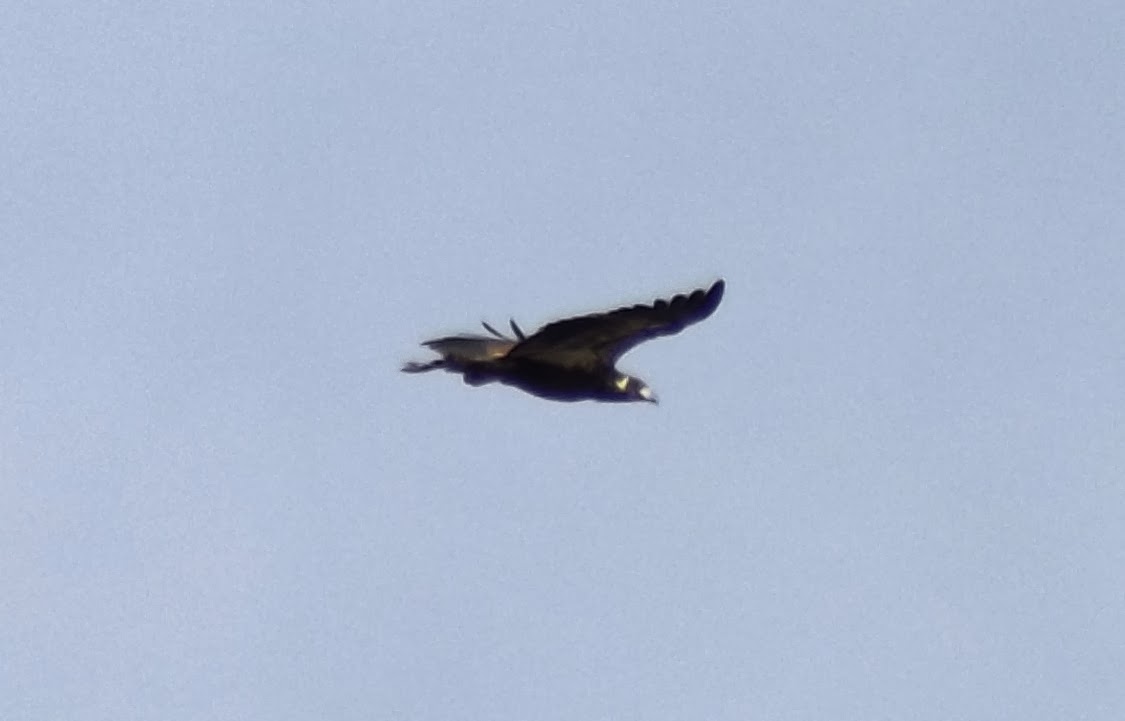
"What?" I thought as I ransacked my pack for the camera.  Paul was retrieving his from his fanny pack as well.   I had only heard of one Bald Eagle sighting in eastern Tucson, seen during a Christmas Bird Count in Redington Pass.  This bird had originally been flying low and slow, possibly indicating it had just taken flight from a roost.  We snapped away as the juvenile eagle circled us, climbing higher as it slowly headed east toward the Rincons.   One or two photos actually came out legibly;


 I thanked Paul for his incredible find in our neighborhood.   As we moved on an Ash-throated Flycatcher called, and as we came into a small clearing another Prairie Falcon perched, unafraid of these curious humans.  
The next day I finally found the Black and White Warbler at the loop, a first for this species since a trip to Ecuador years ago.   Who knows what else may show up in our neighborhood in the next weeks or month.   But I feel lucky because I received my Christmas miracle, soaring over the desert on long wings which pierced my soul with its majesty.   Thank you for sharing with me the bewilderment of our amazing neighborhood wildlife.


Saturday, November 30, 2013

A Mountain of Gems on Thanksgiving

Happy late Thanksgiving!  Thursday morning I reminisced about the things for which I am thankful.  I supposed that I am luckier than most in this world.  I looked at Kino's sweet adoring face, his cute cinnamon eyebrows and bright smile always there to cheer me up on the worst of days.   It's been a tough year for him, yet he carries on, stubbornly.  Through the years I think sometimes I carried him but mostly he carried me.   It was now my turn.

I carried him out to the car for an adventure up Mount Lemmon to see the remnants of the first snow, which had fallen last week.   Now that walking is such a struggle for him he loves these trips, even if he is inside the car most of the time.   He also loves the 70's and 80's rock which I play and sing to on the way up.  He is the only one who doesn't mind my singing in the car.  Mrs. S. concludes that it means his hearing is much worse than we thought.  Luckily you, the reader, were spared the video I took of us,  singing to "Wild Thing,"  on the radio as Kino smiled (then hid) in the back seat.   Thank Mrs. S for that save.  


They seemed to be playing rock songs relevant to the two of us the whole way up.  When James Taylor sang "You've got a Friend," it seemed to be a special dedication to our years together.  When we neared the top I parked and I carried Kino to a nice bed of pine needles to lay in, surrounded by snow.  Some dream of a sitting on thrones, but I would find it so uncomfortable.  Give me a seat cushion of sweet smelling pine needles in a conifer forest with the sounds of nuthatches, chickadees, and kinglets around me.  That's my heaven.  

On the way home Kino opted to lay down, his head leaning against my winter shirt.  He was exhausted from the day's excitement but very content.  I knew I would look back on this day as a special time for us, and time can be a luxury when in short supply.   These memories are wealth I seek, for they carry the most value over time.  They are the buried treasure hidden right before our eyes, if we can only open them to see it.    


Such loving eyes!


Here are some other gems collected on Thanksgiving Day for my jewelry box of treasured memories. 

I saw eyes of pure gold,

I beheld the brilliance of turquoise and saphire,

Rubies could be seen dazzling in the sunlight, 


and a table full of rich, delicious vegetarian dishes fit for kings and queens, 
Dishes shown sinclude stuffed pumpkin, mashed potatoes, sweet potatoes, broccoli casserole.  Not shown include croissants, world famous cheese ball and crackers, and delicious cranberry bread, and heavenly deviled eggs.
I feasted in the company of trusting family and friends of royal and colorful character.  We ate, and laughed, and shared our lives, triumphs and struggles in confidence with our trusted companions.  We left with satisfied stomachs and rekindled souls.  
I am thankful for the wealth I have been given in the form of family, friends and companion animals.  I am also thankful for the gift of sharing this beautiful world with so many other remarkably interesting and intelligent inhabitants, who peacefully share our space on this planet. Thank you for appreciating this life and all it inhabitants.


Saturday, November 9, 2013

Sawbill Surprise and Mountain drive with "the guy."

Red-breasted Merganser females
Life has kept me busy these past few weeks so it was nice to get out for an hour or so this morning before Kino's vet appointment.  At the lake things seemed unexciting, so I turned toward the car for a jaunt to Woodland.  Two waterfowl flew just over my head and landed on the lake I had just turned from.   I did not recognize them in flight so fixated the scope on their lean figures.  The long, thin bill, light brown head with a shaggy crest, and lack of contrast between the light chin and fore-neck identified them as the rarest merganser to be found in our area, the Red-breasted Merganser.  This merganser is typically found wintering in the ocean, not desert lakes.   The serrated edges to its long thin bill help it to hold on to its prey which consists mostly of fish.  This rarity showed up when I least expected it, a common phenomenom. 


A buddy biscuit was enough incentive to get Kino up, which is surprising since usually by 11:00 he's sawing logs and immovable.  As I watched him in the car he seemed so happy to be out that I took some pics before we left the car.   It was then that I first thought we could take a drive afterwards up Mount Lemmon.
On the way up we made short stops, and, though Kino was interested in the smells of pine and Juniper, was also content to stay in the car.   It wasn't until we reached the very top that I was able to carry him around and show him some of the magnificent views.


On the way back he sat up and watched the scenery, including a few turkeys crossing the road.  We logged another sunset and enjoyed another day together in this beautiful place.   Thank you for appreciating our wild and not so wild companion animals.  


LinkWithin

http://www.linkwithin.com/install?platform=blogger&site_id=2170911&url=http%3A//tucsonsparrowseeker.blogspot.com/&email=sparrowseeker%40gmail.com