Tuesday, April 2, 2013

Saved Paradise remake

In an earlier post I submitted new lyrics for the song "Big Yellow Taxi."  Since then I've worked on fine tuning it, and still have much more work to do.   But since this has been stagnant for a while I will post the revised yet still flawed version.   Hope it is entertaining, insightful, inspiring, or any other positive description other than "I read it one night when I couldn't sleep and it did the trick!" 
Perhaps if I "put a bird on it," it will be more enjoyable (yard bird of course). Here you go!


A half century ago the song “Big Yellow Taxi,” rocked the environmental movement.  It’s lyrics showed us the impact our actions have on our natural world.  Half a century later we are still struggling to live responsibly and create awareness about the fragility of the world ecosystem.  We have all put up a few parking lots in our life by our actions, or sometimes even by our inaction, which has allowed the environment to be “paved,” over for our human endeavors.   But we can atone for this fact by creating positive change in our own yards.  Encouraging wildlife on our property can help compensate for the wildlife we displaced when our home was built.   Who knows, if everyone focused on changing their own yard for the benefit of wildlife it could naturally cause a deeper awareness and change in the world.  In the words of Mahatma Gandhi, “It may seem insignificant, but it is most important that you do it.”  With that thought, here are some new lyrics to an old, unforgettable tune.

Saved Paradise
We saved paradise,
And created a birding spot
Using native plants and trees,
It’s now a migration hotspot!

Don’t you know, you need to know
Where others reap we’ve got to sow,
We can save paradise,
By creating a birding spot

Plant your desert trees
With understory grasses and plants,
Perhaps a water feature,
and places for lizards, toads, and ants,

Don’t it always seem to go
That we don’t know what we’ve got ‘til it’s gone
But we can save paradise
By creating a birding spot!

Stack wood in the corner
a cover of leaves on the ground
a stone wall’s crevices
keeps towhees and wrens comin’  round

As you know and studies show
The food chain for birds starts pretty low
We can provide habitat
Creating our birding spot!

Hey homeowners
Please don’t spray your yard
It contaminates our water
And on nature it’s oh so hard, Pleeeease,

If you have a weed, then grab a hoe,
The insects outside just leave them alone,
They support wildlife
When creating a birding spot!


When we live with nature
Everything has a role
There are no pests or varmints
When species diversity is the goal!

Then we’ll know in our very soul
How each life on this earth is so valuable
We can save paradise
By creating a birding spot!

Hey Kittie Kittie
We need to keep you inside
Cause when we leave you out,
The birds and lizards tend to hide!

Oh, even though we love you so,
The impact you have just can’t be ignored
Help us save paradise
By creating a birding spot!

Use a gray-water system,
To water your trees and plants,
Water harvesting techniques
creates a naturescape totally enhanced

Then we’ll know, our efforts will show
When the washes run with perennial flow,
We saved paradise,
and created a birding spot!

Create your own mini refuge,
Become a wildlife fan,
Let your neighbors see
Living with nature is no scam,


Then we’ll know, we all will know,
That we’re saving this earth for after we’ve gone,
Saved nature’s paradise,
And created a birding spot!

So you’d like to get started  
On creating a birding spot!
Tucson Audubon can help
Check out their cool workshops

Then we’ll know, we all will know,
We’ll sing it out like a warbler’s song,
We saved paradise,
By created a birding spot!

Under the spell of Lower Tanque Verde Falls


Sunday I hiked an area where our neighborhood wash meets the mountains.  My hike started high, then traversed through various switchbacks down the steep rocky slope of a canyon.  It may have been easier if I hadn't mistaken an animal trail for the main trail, which took a more direct and challenging route to the stream below.   On the trail birds were scarce save for a calling Ash-throated Flycatcher and Cactus Wrens.   As I finally descended to the running stream below it seemed I had stumbled into a natural paradise.  Steep cliffs on either side of the stream seemed to tower over the rich ecosystem in a protective stance.   As I braced myself against a large boulder a Canyon Treefrog leaped, and as he landed on the rock below, his camouflaged body seemed to melt into the stone's grainy pattern.  Two other tree frogs were barely discernible as the clutched to a small shady crevice on the huge boulder I was using for support.  

The musical chorus began as I entered this tiny world of enchantment.   Canyon Wrens belted out their sweet melodic song, which echoed back and forth against the opposing cliff faces.  A Bell's Vireo squeaked out his message for a mate, and a Lincoln's Sparrow "chucked," from the dense understory of grasses and plants.   Scolding Cactus Wrens seemed to be all around, and White-thoated Swifts chattered as they circled the canyon, their crescent-shaped wings slicing through the strong breeze as they banked against the steep canyon walls.   Some Turkey Vultures decided to use the funneled air currents to lift themselves up effortlessly as they explored this scenic passage from above.   A Common Raven flew to an eyrie 2/3rds up one sheer wall, probably staking out a nest.  

The huge obstacle course of boulders seemed to block my passage to other interesting areas upstream, yet I was content in my little section of heaven.   The Canyon Wrens were holding their territory, the lowest nest area I've seen for this species around Tucson, and at almost the same elevation.   A House Wren was also on the scene, entering Saguaro holes, probably in search for spiders.   As my eyes watched the slopes they picked up an oddity, a Great Horned Owl roosting on the ground up the steep rocky slope, his stern eye scolding me for my discovery. 

Raptor Swim March 6 2013

I stopped by the lake on my bike ride home from work and found it teaming with ducks as it has been most evenings this winter.   A handfull of Ruddy Ducks, a couple Pied Billed Grebes, coots, and larger numbers of Northern Shovelers and American Widgeon, the widgeons numbering over a hundred.  As I watched I heard the call of a female Wood Duck, which has been seen sporadically since early winter.   Even with her distinct

Monday, February 4, 2013

2009 A Good Year

This post has been in the draft section for quite a while-hope you find it inspirational.


Although birds can be unpredictable there can also patterns to their migration, based on food supplies, climate, sudden storms or hurricanes, and cyclical factors.   In any given year some bird species change their habits, showing up further south than usual (or east, west, north), or in different habitats and elevations.   If one species is seen early in the year in different habitat, you may find birders making predictions of an "irruption year" for the species, or for a group of species.   In years of higher than expected precipitation, Cassin's Sparrows may expand their range to other areas previously not used.   If the lemming population crashes, Snowy Owls may be seen as far south as Colorado and Texas, as in 2011.   A hurricane traveling north from the Gulf of Mexico it may bring pelicans, terns, or a jaeger to Arizona.

Part of the joy of birding is that birds are more unpredictable than other animals, especially ones without wings.   For example, I imagine an Arctic Fox being seen in the lower 48 would cause quite a stir, but many Arctic bird species are seen regularly in southern states in migration or as a winter residents.  Sometimes a stray turns up unexpectedly, like the first ever Snow Bunting in Arizona.  One of my strangest sightings in our neighborhood was a Sabine's Gull, which typically summers in the Arctic and migrates over the ocean to its winter "grounds," in the ocean off the coast of South America!

Birders are always trying to predict bird behavior based on new variables in the bird equation,, but sometimes, like the weather, indicators of change don't always produce the result expected.  Sometimes change comes when no indicators are present, and we have to guess at explanations after the fact.   A classic example of this was the Aspen fire in 2003 which burned about 85,000 acres in the Santa Catalina Mountains over a month long period.  There were mutterings of an invasion of mountain species to the lowlands that winter once the cold weather hit, yet the impact was minimal.  I was especially hopeful, being so close to the burning mountain that ashes from the fire actually made it to our yard.   As the year ended only a couple new birds were added to the neighborhood list.  Five years later our neighborhood did experienced the mass irruption I had so eagerly anticipated, though no specific cause for this event come to mind.

It was December, 2008.   By all accounts it was a boring year without any significant events to influence bird migration.  But strange sightings just just sort of happened, slowly at first, then, as one event influenced another, the excitement accelerated like a symphonic number, with many instruments contributing to the success of the masterpiece.  Many of these sightings are attributed to the influx of birders into areas which do not typically receive as much attention as, say, Madera Canyon.  It is akin to a rare jewel being found in an unexpected place, leading to discoveries of other precious gems.     

December 5th, 2008
I was walking in the wash by the cattail pond with my good friends Harry and Joanne, when a sparrow hopped up on a low bush, then disappeared into the foliage.  "That looked like a Rufous-crowned Sparrow," I replied.   A sparrow of slightly higher elevations, I hadn't heard of any reports of this bird inside Tucson, and it didn't offer another look until after the new year.   

December 10th, 2008
I was returning home from an errand and took the scenic route along the woodland road.  I noticed a group of birders intently looking into a field.   I knew something was up and stopped to inquire.   A Common Grackle had been seen, which is not at all common in Arizona.   I got some looks at the bird discovered by Keith Kamper, and incredible birder and friend.  

December 15th, 2008
Keith rediscovered the Common Grackle for the Christmas Bird Count when we covered the area. 
My friend Kendall also helped cover our designated area, staying 'til late afternoon.  He dropped me off at the end of the woodland road to walk home for the final hours of the count.  I felt relaxed and at one with my surroundings, casually walking and recording birds along the way.   I came to a field on the left, which looked "park-like" with short-cropped brown grass and large mesquites just spaced far enough apart that the branches barely touched its neighbor.   A largish flycatcher flew from one of the branches, catching my attention.   The orangish lower mandible and slight crest made me think twice.  The vest with yellowish tinge coming up the center had me scrambling for my guide and video camera.  "It can't be,"  I thought as I turned on the video camera.   Greater Pewee is a summer bird of the high mountains!  As I cursed the video camera's automatic focus I also reveled in the discovery.   I would discover afterward that Greater Pewee's are a "casual transient and winter resident in riparian woodland and isolated groves of trees and parks in the lowlands."(Tucson Audubon Society's Finding Birds in Southeast Arizona, sixth edition, page 250, compiled by David Stejskal and Gary H Rosenberg, Editor-Clark Blake).  This location seemed to meet all the criteria for this species casually seen in the lowlands.  "Casually," translates to "Does not occur annually; cannot be expected to be seen," as written on page 219 of the source referenced above. 

In January I rediscovered the Rufous-crowned Sparrow, which would stay sporadically for years!  Later that spring I was walking Kino by the big pond and saw a strange bird sitting on the lawn.   It was a Wilson's Phalarope, yet its behavior threw doubt at my conclusion, since this species is typically seen spinning around in circles in the water, not sitting on grassy lawns.  I was excited for this first discovery but concerned for its safety.  Later Mrs S and I went back to check on her, but it seemed she had left.   I saw a spec across the pond and walked over for a closer look.  It was our bird, sitting on the bank, and 2 nearby roadrunners ready to close in for an easy meal.  I sat down ten feet away against the bank with bare feet in the water, then edged closer, and closer still.   When I was only a couple feet away I cupped my hand under her and carried her away.  A couple weeks in the rehabilitation center and she was right as rain again, and when the cage opened, she flew up and out of sight, off to new adventures.

It was a summer afternoon, and I hadn't gone out birding in the morning.  I convinced Mrs S to accompany me to the cattail pond for just a short walk.  A funny warbler caught my eye in the cattails.  My first Prothonotary Warbler!  It was not only a first for the neighborhood, but a life bird as well.   On another visit to the pond with Mrs. S. I heard a familiar call, at least familiar if I was another 3000 feet higher in elevation!   "That sounded like a Mexican Jay!" I exclaimed.   I walked out of the cover of the trees to see the Mexican Jay on the shoreline, and shot a quick video before it disappeared, never to be refound!  According to the same issue of Finding Birds in Southeast Arizona, "Flocks rarely wander out of oaks into other habitats."  I certainly hadn't heard or read of this, yet 2 other sightings in lowlands were reported afterward in the same year.  

I gave the video to my friends Mark and Molly, who verified the Mexican Jay sighting.  They have been so helpful over the years in my quest for knowledge on nature.   They also made a trip to the cattail pond, discovering an Eastern Phoebe, another new bird for our neighborhood!    Both Mark and Molly seem to have an aura which draws rare birds to them, or perhaps they have an awareness not attained by others.   Either way, they seem to bring out the best birds in an area.  It's almost like birds come out to see them!  In fact, it seems whenever I mention a bird in our conversations, that species tends to show up not long afterward. 

Perhaps their visit brought some luck to myself as well.  A Willow Flycatcher in the Gooding's Willow at our cattail pond was a great find.  And an overgrown field on the woodland road was bringing out very interesting birds as well.   As I stood by the fence a small sparrow hopped up to a branch looking slightly like a junco but with a sparrow-like back and longish thin tail.  This Black-chinned Sparrow was certainly unexpected, another mountain species dropping down into the lowlands.   Another trip to the field produced another rare bird, a Dickcissel, which gave me great looks and a chance to record its presence!  

Shortly thereafter I was biking home after a late work meeting.   It was almost dark when I got to our neighborhood after the woodland road.  As I entered the field area a sparrow ran a short distance in front of me.  That behavior got me excited.  I could only think of one sparrow which is known for running along the ground.   Sure enough, a closer look confirmed its identity as a Sage Sparrow, possibly the first record inside the Tucson city limits (see earlier post for complete Sage Sparrow story).

Mark and Molly visited again, and we found the Rufous-crowned Sparrow and Sage Sparrow.  The Sage Sparrow would only stay for one weekend, but the memories were priceless.  And yes,Mark and I had discussed the possibilities of Sage Sparrow in our area in one of our previous conversations. 

It was late Autumn and the pecans along the woodland road were attracting a lot of ravens and woodpeckers.   As I walked along I heard a different call recognized from years earlier when I lived back east.   Could that be a crow?  American Crows are very rare in Pima County, but occasionally irrupt into areas in western Arizona.  I spotted it again just as if flew to the ground about 75 yards away.  I shot some video through the scope to document this exciting sighting and gave the tape to Mark and Molly for verification.  This intelligent bird, so common everywhere else, is a rare find in Arizona, especially Tucson.    

November 19th 2009
At the time I only read sparce details about a very rare bird discovered on the woodland road.  On the AZFO website it would show that this species only shows up in Arizona every 2-3 years and this was only the second record for Pima County.  Due to a recent population crash with this species it was expected to be even rarer in the foreseeable future.   It was only later that I learned of the full story of this discovery from my friend Mark, which shows just how connected extraordinary events can be sometimes.

Mark and Molly were birding with friends in far eastern Tucson including Keith Kamper.   From what I know, it seems everyone in their group were world class birders.   On the way back Mark suggested a stop at the woodland road to check for the recent American Crow I had seen.    As they search Molly suggested, "we should check these blackbird flocks for Rusty Blackbird while we're here." The woodland road has a lot of blackbirds in winter and the task of searching every bird in every flock could be daunting, with a slim chance of success."  But then again, Mark and Molly tend to produce miraculous sightings on their excursions, gleaning gems from flocks of seeming ordinary stones (birds). 

"You won't believe it,"  Mark replied.   "I have a Rusty Blackbird!"   It was in the first flock they searched.   Suddenly the woodland road was full of birders to catch a glimpse of this wonder.   Despite our neighborhood's birdiness, it doesn't get the attention of other areas since it is not a major migration route.  The next series of events can best be described as the "rare bird effect," which states that when a rare bird is seen in an area, the resulting attention to the area by other birders can result in the discovery of other rare birds. 

November 21st 2012
The post seemed so casual but the facts jumped off the page.  Robert Payne reported that he had seen an Arizona Woodpecker while birding along our woodland stretch.  Whaaatttt!  This permanent resident of the oaks in the mountains reaches its northernmost range is in southern Arizona, and seemingly never strays from it's upper elevation haunts!  Even in the mountains it is a tough bird to record for the Christmas Bird Count.  I wanted desperately to see this bird knowing this may be the only time I would have the opportunity.  It took days, but I would finally see this bird for myself later while enjoying other exciting discoveries.  Later the next spring I would rediscover ti for myself on a different section of the road, but I will always be indebted to Robert for his unique observation that day. 

November 22nd 2012.  Above the Fray.
Richard Fray was one of the expert birders visiting the woodland road during that time.   But an interesting Warbler caught his attention and he documented it with some great photographs, sharing his discovery with the bird community.  When word got out that a Bay-breasted Warbler was discovered in this gem of an area, all hell broke loose, bird-wise.  This was only the 2nd record of this species in Arizona since 1996 and only 15 total Arizona records (AZFO website).   Last year I had the chance to thank Richard for his discovery while we were on a birdathon.  His discovery was incredibly special in itself, and would be a first ever for the our CBC circle that year (as a count week bird only) and would also lead to a special discovery of my own.

November 24th 2012. 
Luckily I had the week off when I read the post on the Bay-breasted Warbler and raced over.  Two other birders already had it in their sights and I was able to get incredible views of this new neighborhood bird.   As we watched a flock of Dark-eyed Juncos flew into the trees in front of us.  Dark-eyed Juncos are also uncommon but regular in the lowlands, but this was an exceptional year.  As I perused the flock one bird turned and I caught sight of it's yellow eye.   "I have a Yellow-eyed Junco!" I exclaimed.   My sighting was confirmed quickly, but it may have seemed hard to compare it with the Bay-breasted Warbler still present.  

The Yellow-eyed Junco was a first for my neighborhood and I knew it was rare in the lowlands, but wasn't sure just how rare.  Andrew Core came by shortly after and discovered the bird for himself as well, but gave me credit even though I had not called it in.  H also posed the question of rarity to the birding community.  The impressive response can best be quoted in the link below;

http://www.azfo.org/gallery/2009/html5/Yellow-eyed_Junco_Woodland_Core_20091122.html

As mentioned earlier I rediscovered the Bay-breasted Warbler for the Christmas Bird Count in our area during the count week, but it would be the last time I would see it.  I also rediscovered the Arizona Woodpecker one spring day on the western end of the road.  I still find it amazing how many new birds were added to the neighborhood list that year, thanks to wayward wanderers, downward travelers, strange coincidences, and the expertise of fellow nature enthusiasts.  I am so thankful for the appreciation given to this unique area during that time and for the rare gems which were discovered.  Thank you appreciating our amazing neighborhood jewels, some of which we see every day!

2008-9 New Species

Greater Pewee
Rufous-crowned Sparrow
Wilson's Phalarope
Mexican Jay
Eastern Phoebe 
Dickcissel 
Willow Flycatcher
Sage Sparrow
Prothonotary Warbler 
Black-chinned Sparrow
American Crow
Rusty Blackbird - ironically all my attempts to find this bird were unsuccessful. 
Bay-breasted Warbler 
Yellow-eyed Junco
Arizona Woodpecker

Tuesday, August 14, 2012

Saved Paradise and created a birding spot


Yeah, uh, if you're not into reading political opinion this blog entry may not be for you.   I would recommend skipping to another entry. 


In a previous post I made reference to a classic Joni Mitchell song, "Big Yellow Taxi."   The song is such a classic and seems to define the way nature has been paved over this past century. It has got to be one of the top ten influential songs of the era.   This song has influenced me personally in seeing the big picture, and the importance of having personal accounting for our own effect on this planet, hopefully counteracting negative actions with positive steps for the benefit of our natural environment.     

It's been over forty years since the song came out and it seems we are still making the same mistakes as always, putting economic progress ahead of environmental conservation.  I decided to write an alternate personal version hoping it will empowers me to live more with nature.  I could only imagine how the world would change if we all (myself included) paved the way for nature to rebound and thrive as it has before we mettled with our bright ideas designed for self preservation.  The best place to start to make a difference is in our own yard, and let it grow from there.  Being an active nature enthusiast I have seen the positive effect of even seemingly insignificant improvements to the environment. 

Unfortunately I do not have the way with words and lyrics that Joni Mitchell had, and the time it took to write this attests to that obvious fact.  Thankfully Mrs. S helped iron out the more obvious errors, but I hope it is at least satisfactory to the reader and not too cheesy.  Moreover, I hope it honors the tremendous influence Joni Mitchell has had on our environmental awareness.   Thank you Joni  for appreciating our natural world and calling us out to preserve it for future generations!     


Saved Paradise

We saved paradise,
And created a birding spot
Using native plants and trees,
It’s now a migration hotspot!

Don’t you know, you’ve got to know
where others reap we’ve got to sow,
We can save paradise,
By creating a birding spot

Friday, August 10, 2012

Mrs. Humms and start of fall migration

 
Field W of Big pond facing TV Wash

Baby Rufous-winged Sparrow

This has been one wet monsoon, the best one in quite a while.   We still have a month left but the rains have been so steady I don't worry too much about watering our yard.  The field west of the big pond is really looking green, with hardly a bare patch.  The new growth has attracted new migrants, and as I gingerly walked through it I came upon a Gray Flycatcher, Lark Sparrows, Gambel's Quail, Phainopepla, Cactus Wren, and a family of Rufous-winged Sparrows with at least one cute baby.  Toward evening Lesser Nighthawks circled about the pond and over the cottonwoods frenziedly feasting on the abundant flying insects.  In turn a bunch of small flying insects feasted on my unprotected legs still salty from my ride home. 


I also spotted a mystery bird, which perched briefly low in a small mesquite, which appeared to be a small flycatcher in the family empidonax but without an eyering, short wings and a narrow long rounded tail.   The lack of an eyering would point toward Willow Flycatcher some other features didn't seem to match, especially the tiny size and thin tail.   A brief attempt to relocate today and document was unsuccessful, but I did spot a group of Chipping Sparrows sporting sharp new plumage.

Mrs Humm's nest just after hatching
Although Mrs. S isn't a birder per say, she seems a bit obsessed with our Broad-billed Hummingbird nest.   She really identifies with the mother caring for her young, and worries when the wind gusts before each monsoon, the nest swinging on its fragile vine as "Mrs Humms," sits inside protecting the eggs.   At least one baby hatched on Wednesday and I've been finding our binoculars on our couch as Mrs S keeps a vigilant watch, tracking her comings and goings.  


A couple days ago my friend Mark emailed me about a Crested Caracara seen on the outskirts of our neighborhood, which has peaked my interest since it would be new for my list, and a life bird.  I plan on hitting the trail tomorrow for a relaxed bird walk in the morning.  Elsewhere in Southern Arizona are reports of Painted Buntings, Red-eyed Vireo and a Scisssor-tailed Flycatcher, which are all birds yet to be seen in this rich patch of riparian desert.    Wish me luck tomorrow!

Thank you for your appreciation of our remarkably wet and lush desert. 


Tuesday, August 7, 2012

Elusive Pelicans and Labor Day Bears

This weekend I took a break from birding, not even stopping by our ponds.  On Monday while riding to the bus stop Heidi, one of our neighbors asked, "Did you see the pelicans this weekend?  They were on the big lake Saturday and Sunday."  I hid my grimace as I thanked her for the information and raced to the pond to get a quick look.  They were gone.

I thought through my apparent unlucky streak with the two species of pelican in our neighborhood. I remembered how I had specifically checked the ponds each weekday for pelicans on the way home from work this week, knowing there were reports in the area.  Am I losing my birding touch?  Did I ever have one?  At least I did see one Brown Pelican our of five opportunities in our area.  

I seem to have similar luck with Mountain Lions here.  Our neighbor two doors down had one in her front yard when she went to get the paper (and she didn't call!).  Other neighbors have seen them as well but I keep missing out.   I really hope this year is the year I see one in the wild, and in our neighborhood.  Seeing this magnificent hunter is one of the reasons I moved to Arizona!

Perhaps I'm being too hard on myself.  I am appreciative of the birds and animals I see each day.  Like the toad which hopped across our porch at my feet Sunday night.   Or the baby Western banded Gecko at our front door last night.  The Abert's Towhee which felt comfortable enough to feed close to the porch where I sat, enjoying the moment.  The nice and frequent rain showers we've had recently which could make for a great migration spectacle!   I gather most people haven't seen 240 plus bird species in their neighborhood, for which I consider myself most fortunate.  

Another very lucky moment for me occurred Labor Day Weekend some years ago........

It was barely light out and I had just started a point count for the Tucson Bird Count.  I point count is when you record birds heard and seen in five minutes while standing in one predetermined spot.  I believe my record is 24 species in a five minute period.   I was overlooking a resort with a open area used occasionally as a driving range.  A major wash ran behind me flowing into a nice area of mesquites, Arizona Walnuts, Mexican Elderberry, Western Soapberry, Arizona Ash, and Desert Willow.   Upstream was Eucalyptus, cottonwoods and mesquites, with an understory of Desert Broom and acacias, and a small duck pond adding variety to the habitat.

I had just started the clock when the coyotes began barking defensively.  "That's strange," I thought curiously.   "Why would they be barking at me when I'm half a football field away!"  Coyotes have barked at me before if I'm close to a den or if I surprise them, but something here didn't seem right.  They seemed very alarmed, yet no one else was around!  As I listened for birds I also scanned for views of the coyotes, which were still just out of sight.  A minute into the count I spotted the group in the open and focused my binoculars as they ran about, their desert gray coats blending into the scenery as they chased....

A black shape entered the field of view, with powerful front paws and a low center of gravity as it raced around them in a figure eight, before running behind the pond and out of view.   I could hardly believe my eyes, a Black Bear in the desert valley!    This was news.   It would make the papers, and probably the nighttime news as well.  Game and Fish would need to be involved for sure.   It was so exciting to see this mountain species traveling through our desert, a rare jewel of an experience to be treasured.  

I remember some years back hearing of another bear coming through Tucson in similar manner.   As I traced the map of sightings it ran straight through our neighborhood, though no one saw it here.   I surmised he was going from the Rincon mountain range to the Catalinas, taking the desert route so as to avoid conflict with other bear territories.  Our network of washes is the last viable route for this task, which was probably done on more of a regular basis before the area became saturated with people.  It probably increased the biodiversity of the "Sky Island," populations of Black Bears.  Our mountains are called "Sky Islands," since the lush cool upper elevation habitats are separated from one another by desert, preventing a continuous population range for many species.   These wandering individuals could be the key to the diversity of the entire population!

This smaller bear of a approximately a hundred pounds was probably on the same course as it's predecessor.   Up the Agua and TV, then up Sabino Creek or the Rillito to the Catalinas.  It was about ten miles, but it would need to use its stealth as an advantage traversing the territory of humans. 

Part of its stealth would depend on my actions.  I would not tilt the scales against him despite my excitement, so I could assure his safe journey.  I did web searches later and found his travels did not go undetected, but by that time his trip was almost complete, and he was successful in avoiding human capture.   I also learned later that others had seen him, almost at the same time as I, and had taken the same action as I, just cherishing the moment in silence.  

I am honored to have been given the gift of this memory, and hope this bear is still living happily in our Sky Island paradise!  Thank you for letting me share this unique enriching experience with you. 

The Benefits of Cattails

Recently I wrote a letter to a friend who's community had a beautiful cattail pond, only to find it was diminished to a fragment of its original splendor.  Cattail habitat in southern Arizona is extremely rare, and very conducive to many bird species due to the abundant life it supports in a relatively small area.  But cattails often get categorized with such terms as weeds, pests, varmints, and the like by people who are either misinformed or have a superior sense of royalty over their surroundings.  Many times we react without thinking based on preconceived notions, some perhaps left over even from our childhood.   

Far be it from me to speak of perceived superiority in others when tonight here I was, cutting down cattail stands in my neighborhood pond.   The Cooper's Hawks complained as I worked, and a Yellow Warbler called out in protest.  I knew my argument for the better good wouldn't

Monday, August 6, 2012

For the love of Rhinos

I try not to bring worldly issues to my blog, but this one seemed to really hit home so I will write about it partly to sort my thoughts, and perhaps some good will come of it.  Thank you in advance for listening. 

I was browsing the web news the last week when a headline jumped out at me about the fragility of the current Rhino populations.  The thought of the all Rhinos species becoming extinct during our lifetime became so real to me I became very depressed.  To think that this would be the first large mammal to go extinct since the Woolly Mammoths!   How can we explain that we killed off such a magnificent animal for such selfish motives!  I know this is not the first species we've lost to extinction but just think, "if we can't protect the rhinos, what species is safe?"  Below is the video which explains the situation.
http://news.yahoo.com/video/vietnam-horn-habit-threatens-world-025257898.html

Then on Saturday I went to the bookstore and was browsing the nature section when I my eyes found this  book, "The Last Rhino's," by Lawrence Anthony and Graham Spence.   Coincidence?    My initial urge was to purchase the book since I really seemed to be drawn to it.  And Lawrence Anthony was also author of "The Elephant Whisperer," a bestseller.  But it was a little expensive and I was convinced to check Bookman's for a copy first.  

Tonight I was feeling more depressed since I had just finished removing some cattails from our pond.  Although it prevented more serious action (chemical spraying over expansive area) I still felt like some sort of hypocrite actually removing habitat just to improve a neighbor's "view."   Perhaps I needed to read about successes in environmental protection for positive motivation.   I called 2 Bookman's locations without success, not surprising since the book just came out this year.  As I googled for other dealers I learned that Lawrence Anthony passed away this year just after writing his latest book on the Rhinos. 

Curiosity sent me searching further, and I found this heart wrenching yet positive link about his death, and the "mourners," who gathered in his honor.  You may want to grab a tissue first. 

http://delightmakers.com/news/wild-elephants-gather-inexplicably-mourn-death-of-elephant-whisperer/

I found a copy of his book on Amazon and it is on the way for reading on my bus commute.   I hope it will give me insight on how one man or woman can make a difference in for our animal neighbors in our yard, our neighborhood, and across the world.   I am thankful for your attention if you made it this far.  Last link below appears to be the organization founded by Lawrence Anthony if you would like more information.  

http://www.earthorganization.org/

Thank you for appreciating our natural neighbors here and across the globe!


Wednesday, August 1, 2012

A home for Rufous-wings? Aug 1 2012


Rufous-winged Sparrow March 2011
 
Rufous-winged Sparrow March 2012
          

On the ride from the bus stop to work I lamented on a lot that was just cleared of vegetation opposite my workplace.   It wasn't the best habitat in the world, but had attracted many good birds over the years. Recently it even had nesting Black-throated Sparrows, a rarity in mid Tucson..  I remember seeing Northern Harriers hunting its boundaries in winter, and Lesser Nighthawks hawking insects in daylight hours during the monsoon season.   This spring I had also heard my first Rufous-crowned Sparrow within its borders.   As I sadly pondered the fact that these birds were losing their home a distant and repetitive sound tapped at my thoughts.  I realized it was not my imagination but the real call of a Rufous-winged Sparrow, almost in answer to my pondering questions.   I turned back to appreciate its sweet "ping pong ball," call and silently invited him to our neighborhood if he needed a place to stay for a while

As I rode on I remembered the lyrics to a old favorite tune, "Don't it always seem to go, that you don't know what you got till its gone....


Question:  If a tree falls in the forest and no one is there to hear it, does it make a sound. 
Answer:  A tree is never alone in the forest, and we would be all alone without trees.               
Author.  myself Aug 1 2012     


Monday, July 30, 2012

Monsoon Sunday, survey and storm. July 29 2012

Sunday I surveyed another area east of my neighborhood with my friend Kirk.   This area butts up close to the Rincons along the TV wash, and has some amazing habitat from the additional rainfall in the foothills.  Almost immediately we heard a Summer Tanager calling, and as we approached the running wash we spotted two White-tailed Deer standing in the water upstream, with fresh velvet-covered antlers adorning their heads as they enjoyed an early morning drink.  


Tiny desert toads were so numerous we had to walk slowly to allow them time to scamper from our path, and pools of water were teeming with tadpoles.   A bobcat traversed a tributary to our left and found safe haven in the thick vegetation.  This is the magic of the monsoon, Arizona's fifth and most precious season.  The desert is now just beginning its second and most substantial growing season, cherished by new baby birds, and early migrants.  Some nestlings, especially raptors, have even left to explore new territories, something called "post monsoon dispersal."    

The startling call had a loon-like quality to it as it pushed through the cottonwoods to our ears.  We recognized this piercing call as belonging to a Gray Hawk, and we rushed for a view of this elusive hunter.  "There, in some open branches!?  I set up the scope, turned on the camera, and managed one back shot before it took flight.  It was a juvenile molting into adult plumage, as seen by the tail section in this photo.  


We heard infrequent calls but couldn't relocate it for a bit.   Then Kirk pointed,"There!" as we watched it fly across the wash, getting great views of its white rump, a distinctive field mark.  We thought that was the end of our sightings, yet the hawk would give us one more show, allowing me to capture a few more images as it peered through the branches of a dead tree. 


Even as we watched, I couldn't help being distracted by a male Blue Grosbeak in the brush before us.   Then a Great Horned Owl flew through the mesquites, disappearing again against the similar looking mesquite trunks.  I thought I heard the loud trill of a Tropical Kingbird, but never got a second chance to hear the call.  A Harris's Hawk stood tall against an exposed branch.   I heard a "ZZZZZZ," call from the vegetation, recognizing it as a bunting.   I watched as a drab brown female Lazuli Bunting flew from the cover to a open branch.   Then a brilliant male followed, staying just long enough for a couple haphazard shots. 

Before leaving the wash we managed to plant some Sycamore seeds I'd been holding, and I was referenced as, "Johnny Appleseed." for the second time in a week.  I'd actually hope for a better name, maybe "Sycamore Sam," or the like, since these seeds were natural and from the same wash. No name would be nice too, just so long as I can see the wash flowing as it has in years past. 


Later that afternoon we received the most thunderous storm of the season.  One of the thunderous bolts shook the walls as it boomed angrily at the world, and apparently awakened our resident Couch's Spadefoot, who immediately began calling out.   This toad's mating call sounds more like a complaint against being woken rather than a musical serenade.  I watched, though, and soon another toad hopped toward the sound, and disappeared behind the curtains of the mulberry leaves.  


Meanwhile the Broad-billed Hummingbird tucked herself into her nest during the downpour, tail held high, keeping her eggs safe from harm.   
 

Thank you for appreciating nature and the environment on which it thrives.


Saturday, July 21, 2012

IBA survey said.....Peregrine Falcon! July 20 2912

Today I got out to survey one part of the wash, which was accepted as an Important Bird Area this year.   Due to my sunburn experience on Monday (post still in draft stage) I had planned on walking with the sun at my back, since it was already half hour past sunrise, very late for summer birding.  Luckily I drove west toward my essential coffee source first, which runs past the west end of my transect.   There in the magical Eucalyptus mentioned in previous posts was a magnificent Peregrine Falcon!   Plans changed

Friday, July 20, 2012

Backyard wildlife July 19 2012

Yesterday it was partly cloudy so I did a little work on my water retention project-translation- building a stone wall to prevent rainwater from flowing out of our yard.  It is difficult since it is also freestanding and I have limited availability on large rocks.  But this method creates incredible habitat for lizards and the insects they feed upon, which brings more birds and mammals, etc.   I know we humans like to pick our neighbors and yard residents but I find it easier to just roll with the changes rather than continually trying to control the environment.   Removing one element could change others.   Removing scorpions reduces the chances of seeing a Western Screech Owl in the yard.   Spraying for insects affects the lizard population as well as birds, who like to scratch the ground for grubs.  

As I worked I heard the call of a Phainopepla, a bird commonly known as the black cardinal because of its crest.  Though not uncommon it is a rare treat to see one in our yard.  They love to hang out in the mistletoe in mesquites, eating the berries.  We only have one mesquite but luckily our neighbor also has one which flows into our yard, which is where I found this juvenile bird well hidden within the branches.


 Some lizards also came out to investigate my work and give their input.


For the last few days now we've had a female Broad-billed Hummingbird get very close to us every time we're on the porch.   It seemed so cute that she took such an interest in studying us so closely.   Today we discovered why her interest was so intense, as she began nest building on our catclaw vine, which grows under our porch's protective roof!   She's a fast worker and by the afternoon it was almost complete!  I was able to snap this picture as she tested the softness of her creation so far!
Thank you for appreciating the incredible wildlife which surrounds us!

Wednesday, July 18, 2012

Mount Lemmon bicycling/birding July 16 2012

If you read my last post you know I had planned to bike up Mount Lemmon on my Birthday (30 miles each way from 2500' to 8200').  So let me start by answering some preliminary questions you may have. 

Did you wake up early enough?                                                  No.
Did you make the attempt anyway?                                            Yes.
Did you take pictures?                                                                  No.
Did you bring the camera?                                                           Yes.
Did you bring the memory card?                                                 No.
What did you bring to document?                                               Video camera.
Did you get good video?                                                              No (automatic focus doesn't work well)
Are you going to torture us with video on the blog anyway.   Yes..no..yes...wait..no..ok no.
Did you make it all the way up to Ski Valley?                            Read on.

I began my ride just after 6:30 AM, later than I usually catch the bus for work.  It was already getting hot, the sun being out for the past hour.  I probably should have rushed straight to the mountain but the birds were singing this time of morning, and this ride was also about observing and appreciating the nature along the way.   Of the 22 species heard and seen on the five mile ride to the base the beautiful male Purple Martin on the telephone wires above me stands out the most. 

The sun's endless heated stare bore down on me for the first five miles to Molino Basin.  I was almost finished with my first liter of water and the trip wasn't half over by far.  The road turned

Sunday, July 15, 2012

Birthday Bicycle Challenge

Well, tomorrow's my Bday and I plan on biking up Mount Lemmon from the house to celebrate.  It's like a bucket list thing to see if I can bike 30 miles from 2500' to Sky Valley at 8200'.   Can I do it?  Maybe.  I did accomplish this feat about 3 years ago preparing for a biking birdathon, but was in much better shape then, and started at the base of the mountain.   I think it will be a success if I wake up in time and attempt the climb.   And yes, the bins are coming too, as my rules do not preclude stopping for good birds.  It's all because of my philosophy (it's not about getting from point A to B, but what you experience along the way).  I will be bringing my Audubon guide for reference and my new pack (both Bday presents from Mrs S and our daughters).
So if it doesn't rain, or I don't oversleep, etc, I hope to have a nice tale to tell tomorrow.   I'm sure

Saturday, July 14, 2012

Pre Birthday Bell's

Today when walking Kino I heard two Bell's Vireo's, one of which was in a resident's yard.  "Lucky Duck!" I thought envying the resident on their nice yard bird.   I did feel lucky the night before watching 3 fledgling Cooper's Hawks in this same area.  After returning our friend Tonya and I went to the cattail pond, which was pretty active.   The first bird was a flushed juvenile Cooper's Hawk in the small mesquite in front of us.  We delighted in our sighting.  Two more steps and another juvenile flushed from the same tree, then another.  Two Cooper's Hawk nests within a small area produced 3 healthy juveniles each.  Wow!   Here are their individual pics!


In the short time we were there we had 24 species, including;
Yellow Warlber, Lucy's Warbler, Bell's Vireo, Great Egret, Northern Mockingbird, Coopers Hawk, Harris's Hawk, Turkey Vulture, Broad-billed Hummingbird, Anna's Hummingbird, Gila Woodpecker, Gambel's Quail, Mourning Dove, White-winged Dove, Purple Martin, Brown-crested Flycatcher, Ash-thoated Flycatcher, Cassin's Kingbird, Bullock's Oriole, Lesser Goldfinch, Mallard, House Sparrow,Cactus Wren, and Verdin. 

Later we sat on the porch watching a rain shower and checking yard birds.   Verdins hopped about the mesquites, and a Great-tailed Grackle gave out high-pitched calls which could have come from dinosaur era.    One of our neighbor's trees drapes over our yard and provides great cover for birds.   When I saw something hopping around in the foliage I figured Verdin or House Sparrow since they had been using it all day.   As it hopped to the outer edge I zoomed in on the familiar face of a silent Bell's Vireo, a first for this year!  These birds are typically heard before seen 99 percent of the time so it must have wanted to surprise us.   I was thankful for such a variety of neighbors visiting our small patch of heaven.  

Thank you for appreciating our natural wildlife! 

Species appreciation -Sage Sparrow


Birding is sometimes like a box of chocolates, you never know what you're going to get... or for that matter, when.   I focus on my neighborhood wildlife I would rather see lifebirds here than travel elsewhere to find them.  It is so much more of an enriching experience, especially if I am the first tgo discover it.  
In some cases, though, it is beneficial to study a bird elsewhere so you know it well enough to recognize it in the neighborhood when it finally does arrive.   Or perhaps it's just that I lose patience and take the easy way out.  One example of lost patience was the Elegant Trogan, for which, after some years of hoping for a sighting in our neighborhood, I broke down and went to Madera Canyon, where I received excellent views. 


It was the same story for the Sage Sparrow.  I had been so hopeful of a sighting in our neighborhood

Sunday, June 24, 2012

Cat Fancy-flashback

Warning:  this entry delves into the political at first.  If you just want to read the entertaining story skip to paragraph five. 


One day when I was out in nature a man approached and we had a conversation about various nature related topics.  He invited me to bird on his property, and mentioned that he has cats that he keeps outside, and every once in a while a Great Horned Owl will take some, but she has other babies.  "It's the way of nature,"  was his shrugging comment.   I had to wonder if he actually believed the words he was saying. 

It's always uncomfortable to hear this philosophy since, for one thing, it isn't true.   Cats are incredible hunters and, left outdoors, are devastating on their environment, which includes birds, mammals, reptiles and insects.  In other words, the ecosystem.   It is not the natural way and throws everything off balance.   It is a terrible situation for the cats as well, who fall victim to coyotes, hawks, owls, and automobiles.   I remember the anguish on a person's face just after they accidentally ran over a cat.   I knew it was one of our neighbor's cats which was allowed to "cruise," the neighborhood.   Even this fact can't remove the guilt you feel toward the victim.  

Being a bird enthusiast you may think I have a vendetta against cats.  You would be incorrect.  In fact, we have our share of cats and love them dearly for their unique personalities, their genuine affection, and incredible capacity for love.    We keep them indoors and all are spayed or neutered.   I highlighted that line since it is the most important part of this entry.   Cats are not the problem.  The actions of humans with regards to cats has created an imbalance which can be corrected with awareness, and, honestly, regulation.   This last action may seem costly until you think of how much it costs to run the humane society and other organizations.   Just think of how many cats are still put down after not being adopted.  It is a sad secret that many cats confiscated from "hoarders," are actually put down when not adopted.  Was there situation really improved?.   Other kittens given away are also at risk from others with harmful intent.  We all know there's a better answer, and California has had success in their endeavors.  Let's work toward a better solution for nature and cats!

I can preach all day but I'd rather tell a story of our cats, and how our bond started with our loving companions.


                                                                Paragraph Five


I was playing "fishing pole," with our cats the other night, and lay down on my stomach as they pounced on my back trying to get their prize.   I suddenly had a sort of deja vue which took me back to our first encounter a few years ago, also in the spring but months earlier.   It's funny how random events can sometimes shape the course of your life....

Friday, June 22, 2012

GBBC and other news

This past week we've added a couple birds to the 2012 yard list.   Today a Ladder-backed Woodpecker was calling from a neighbor's front yard, then came in full view.  Sorry, no pics.   When I was walking Kino last weekend I heard the familiar call of an American Robin, from a Eucalyptus about 30 yards from our house (and clearly would be seen and heard from the house). 

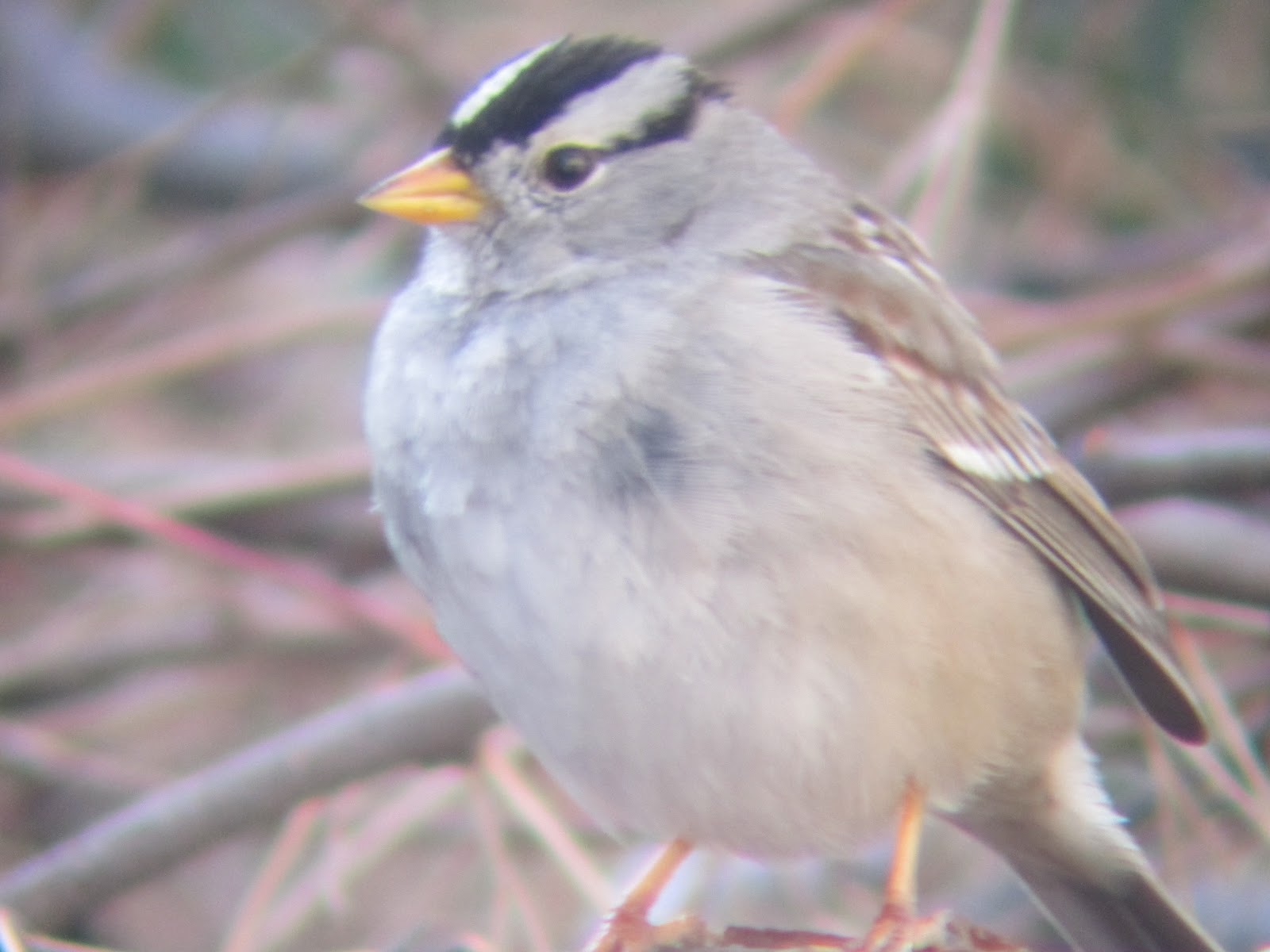
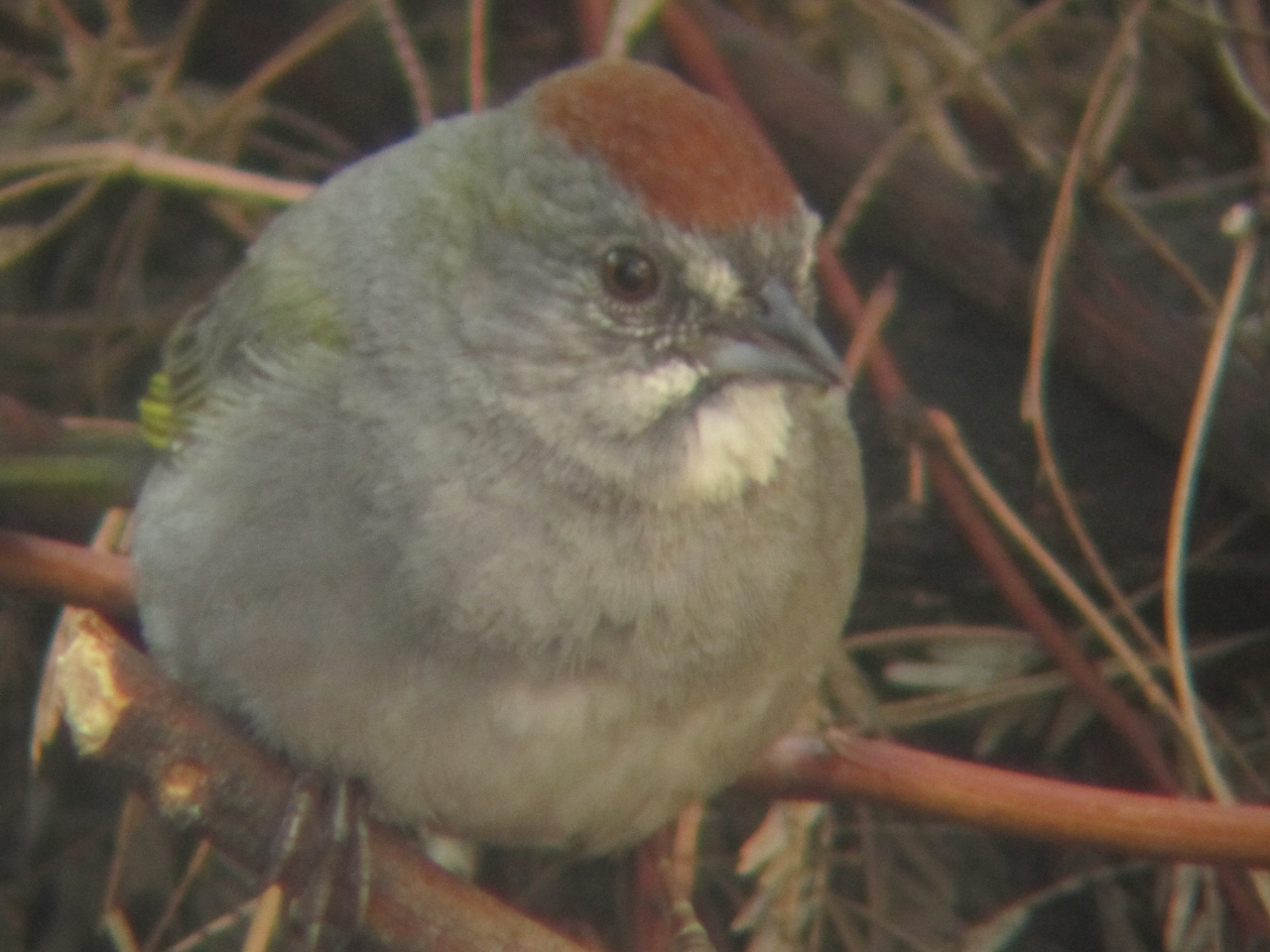
I had a great time counting birds for the Great Backyard Bird Count.  There were many highlights in the yard and neighborhood, and even on Kino's walks.   We tallied about 40 species on one walk alone!   And that's without Kino even trying....really.    We had Western Bluebirds, American Robins, and even a Red-naped Sapsucker.  A Green-tailed Towhee and White-crowned Sparrow cooperated nicely for photos in our back yard, and I managed a plausible shot of an Orange-crowned Warbler at "the TV loop."


The highlight came from a nearby mesquite bosque.  As I entered the mesquites almost immediately I picked out the form of a Long-eared Owl.  

Protective Coopers Hawk and Western Grebe 6/20/12

On the way home today I decided to stop by the cattail pond even though my bins were at home. Tiny reddish dragonflies zipped about the surface of the water like modern day fairies, and a Yellow Warbler fluttered in front of me like the tip of a cartoonists paintbrush ready to color it's beauty on the watery canvas.  The Eucalyptus was shedding it's papery bark, and many strips bore the neatly spaced rows of  Red-naped Sapsucker holes from the previous winter.  A collared lizard scrambled up the trunk of a cottonwood, it's smooth muddy green skin distinguishing it from the spiny lizards in the area.   This strange large lizard is an unusual sight compared to our other varied neighborhood lizard species.
As I walked back a Great Blue Heron's wide circular prints appeared like sand dollars against the thin top layer of loose dirt covering the hard caliche just below.   The heron watched from the opposite bank, it's wings drooped so low they seemed disconnected, in a vain attempted to cool down from the 105 degree ambient temperature.  I  rode home and took Kino to the big lake, hoping for another look at a Western Grebe which has been visiting since the first weekend in June.  This is only the 2nd occurrence of this bird in our neighborhood, the first being a one day wonder 12 years ago. 
Wow!  Unfortunately last Sunday was the last time I saw it, leaving my only some mediocre photograph and some video as a remembrance of this unique experience.


Dusk began to blanket the scene as we walked back toward home.   I felt, then saw the watchful eye of an overly protective Cooper's Hawk from the low branches of a nearby Eucalyptus.   This hawk has a nest close to the walking path, and has been buzzing passers by, especially males, it seems.   He even buzzed Kino a couple times, and I had to put myself cringingly in the path of wrath, hoping it would veer off before impact.   While we have not had a physical encounter yet, a few times I would turn around and see it just a few feet away from my head gliding at a quick clip, then turning for a second swipe.  It has really given me a great respect for the hunting prowess of this medium-sized accipiter.   It reminded me of a distant memory of a Northern Goshawk chasing me from its nesting area.   I broke my pack when I hit the dirt, but it continued to lead me out of the forest with persistence, diving down periodically in punishing manner.  After what seemed like 200 yards he let up.   Unfortunately the trail away took a turn back toward the nest, and the harassment came back at full and angry force, with vocal intimidation as well.  The memory of that charge is still quite vivid in my mind, and, though fearful, was one of the times I felt truly alive and awake.  Here is a quick Blair Witch type video of the Cooper's hawk attack.  If you blink you may miss it. 


As we walked slowly toward home darkness settled in, and a group of about twenty small bats were in a pocket ahead.   As we traveled through they fluttered about us like moths to a light, and I could even feel the heat from their bodies.  A large dragonfly was in their midst, and seemed to hover around us as well, perhaps even using us as screens against the bats sonar detection capabilities.


LinkWithin

http://www.linkwithin.com/install?platform=blogger&site_id=2170911&url=http%3A//tucsonsparrowseeker.blogspot.com/&email=sparrowseeker%40gmail.com